

Mortal Kombat II
The Marketing & Transmedia Playbook

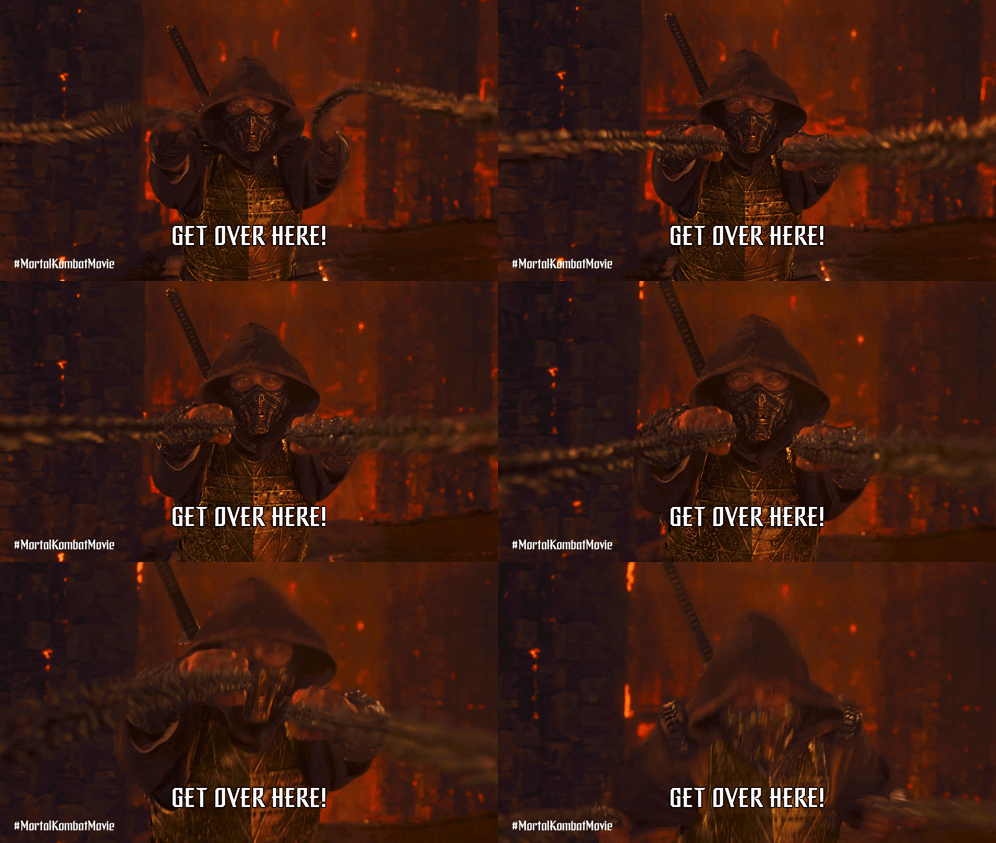
I’ve been sitting on this one for weeks now, purely because there’s just so much to it. Mortal Kombat II released back in May, and between the WWE crossovers, the car cut clean in half in Toronto, and a dragon billboard with an LED backdrop, I genuinely couldn’t bring myself to rush this out. I wanted to do it justice.
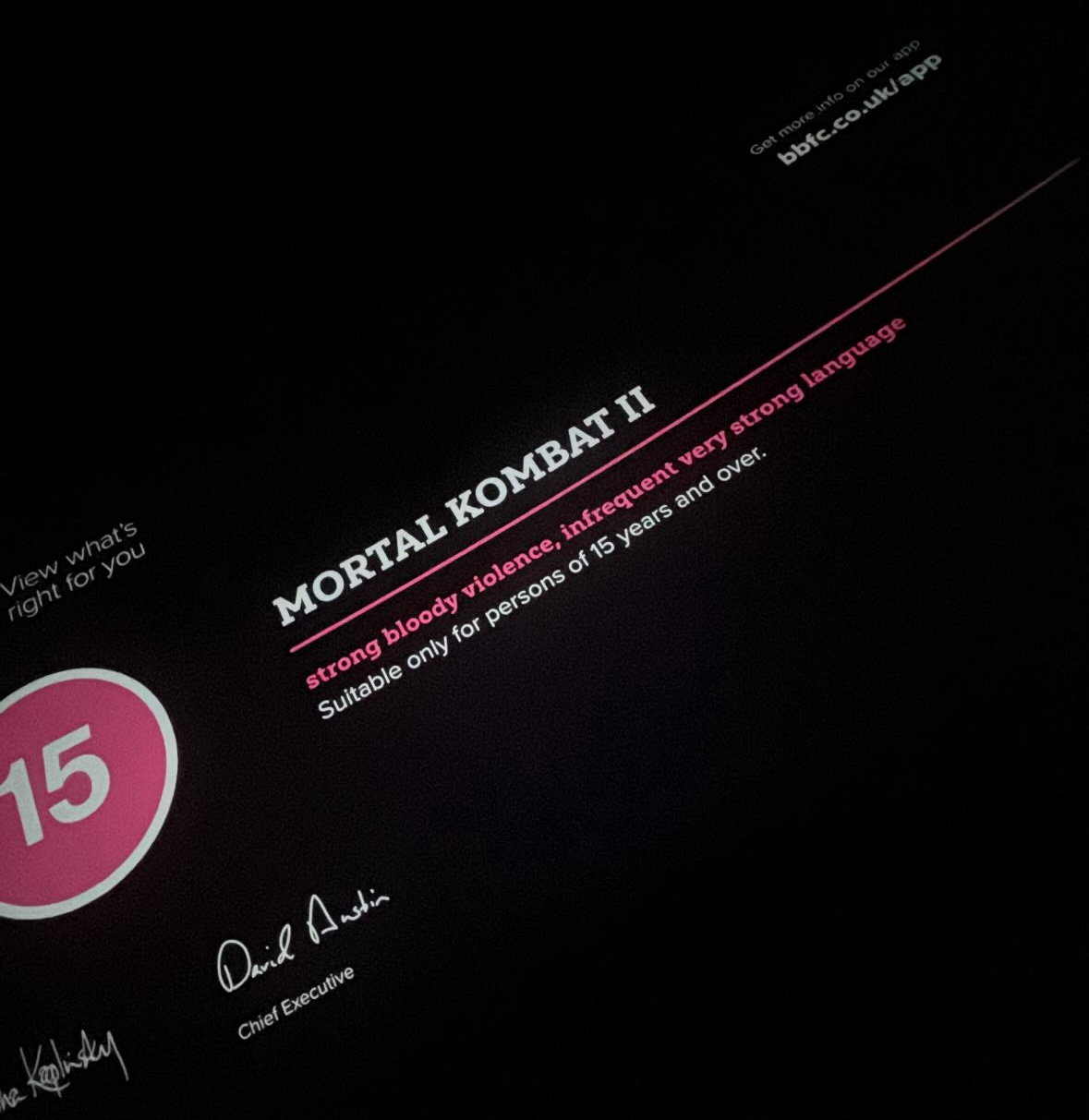
Now, as I typically try to do with all of the films I now write about, I will see it in cinemas. This time around I was lucky enough to catch it with my girlfriend, front row at our local cinema, on opening weekend!
I must say, it was such an improvement when compared to the first, although the standards weren’t that high to begin with. But since then, I’ve just been pondering the MKCU (oh yes, we are bound to get a Mortal Kombat Cinematic Universe) and putting my thoughts down on paper, capturing various examples to pull from and provide you with, and even play more fighting & co-op games with at home with my girlfriend.
Now that I’ve covered my own personal experience, let’s get this thing going; here’s the plan for this one: a quick recap of what Mortal Kombat actually is as a piece of IP (because it’s a genuinely underrated transmedia case study), then jump head first into the marketing, media plan, partnerships and audiences, before segueing into the transmedia layer properly, and wrapping with takeaways.
Let’s get into it.
A Very Quick Recap: What Mortal Kombat Actually Is
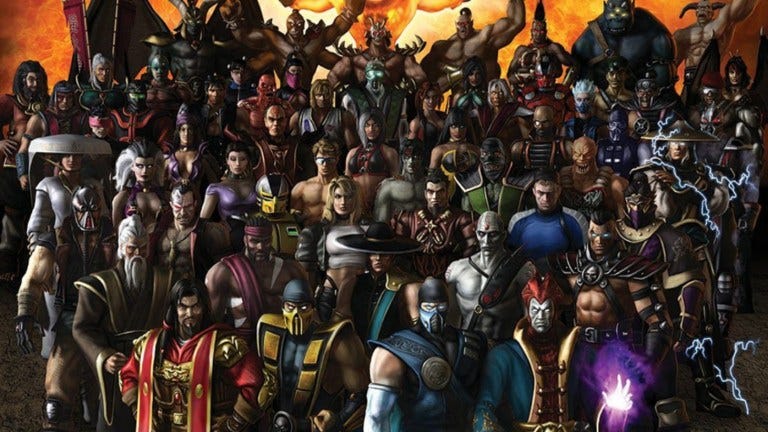
Before I get into the campaign itself, it’s worth zooming out for a second on just how stacked Mortal Kombat is as an IP, because I don’t think people give it enough credit as a transmedia case study.
Mortal Kombat is one of the most successful, durable, and structurally fascinating “world-building” franchises in media history. Originally designed as a 1992 arcade game, it’s spent over three decades fluidly migrating across video games, comic books, feature films, television, and music, proving how a simple premise can expand into a massive, multi-platform narrative universe.


The current cinematic flagship, Mortal Kombat II, released in theatres in May 2026, directed by Simon McQuoid. It works both as a direct sequel to the 2021 reboot and as a piece of fan-service media designed to reconcile the narrative split between the films and the games:
Course-correcting the canon. The 2021 film introduced a movie-exclusive protagonist, Cole Young, which alienated some core game purists (side note: I’m so glad his character was killed off, I genuinely laughed my ass off after seeing that). The sequel side-lines Cole and shifts focus to definitive game icons: Johnny Cage (Karl Urban) and Kitana (Adeline Rudolph).
Adapting the visual lore. Reviews highlight that MKII thrives on translating character skins and ultra-violent Fatalities directly into live action. It operates like an apology tour for the gamers, leaning on interdimensional portals, ancient amulets, and tournament structures that mirror the game logic over standard cinematic pacing.
Theatrical to digital windowing. Showing how modern media companies actually manage transmedia assets, Warner Bros. moved the film to Premium VOD on June 9th, just four weeks after a soft theatrical run. It quickly topped digital charts, proving the modern MK audience consumes media fluidly across physical and digital storefronts.
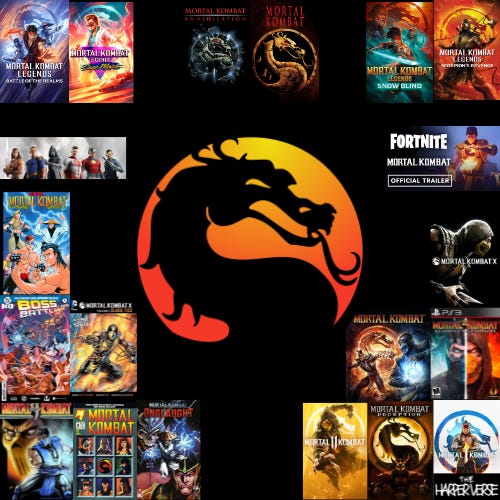
Mortal Kombat as a whole is a textbook example of what you’d call a “radical intertext”. That just means it’s a franchise where you have to engage with multiple types of media to get the complete picture. You see, you’ve got the games as the mothership (25+ titles dictating the grand narrative), the campy 1995 original film and its critically disastrous sequel, an animated series + animated films, a live-action prequel, a gritty web series, original Malibu and DC comics, and - I’ll come back to this properly later - one of the most recognisable sonic identities in gaming history.
Why does the mythos work transmedially though?
Two reasons, really.
First, the realm system: the universe is split into separate dimensions (Earthrealm, Outworld, Netherrealm, etc.) governed by the Elder Gods, and because a realm has to win 10 consecutive tournaments to invade another, creators essentially get a modular framework; they can insert prequels, spin-offs, or character vignettes into different eras or realms without breaking the core continuity.
Second, character archetypes over fixed plots: the colour-coded ninja palette swaps of Scorpion and Sub-Zero, the distinct motivations (revenge, honour, Hollywood vanity), these characters are incredibly elastic and can move from a 2D fighting game grid to live-action film to comic book page, and somehow still look like themselves the whole way through.
From an industry standpoint, MK succeeds because it doesn’t just adapt a story from one medium to another, instead it extends an experience. And while MKII occasionally struggles to balance traditional cinematic screenplays with game mechanics, it successfully satisfies the transmedia consumer’s desire to see interactive gaming imagery brought to life in a shared, passive viewing space.
The Marketing Engine: Where MKII Actually Showed Up
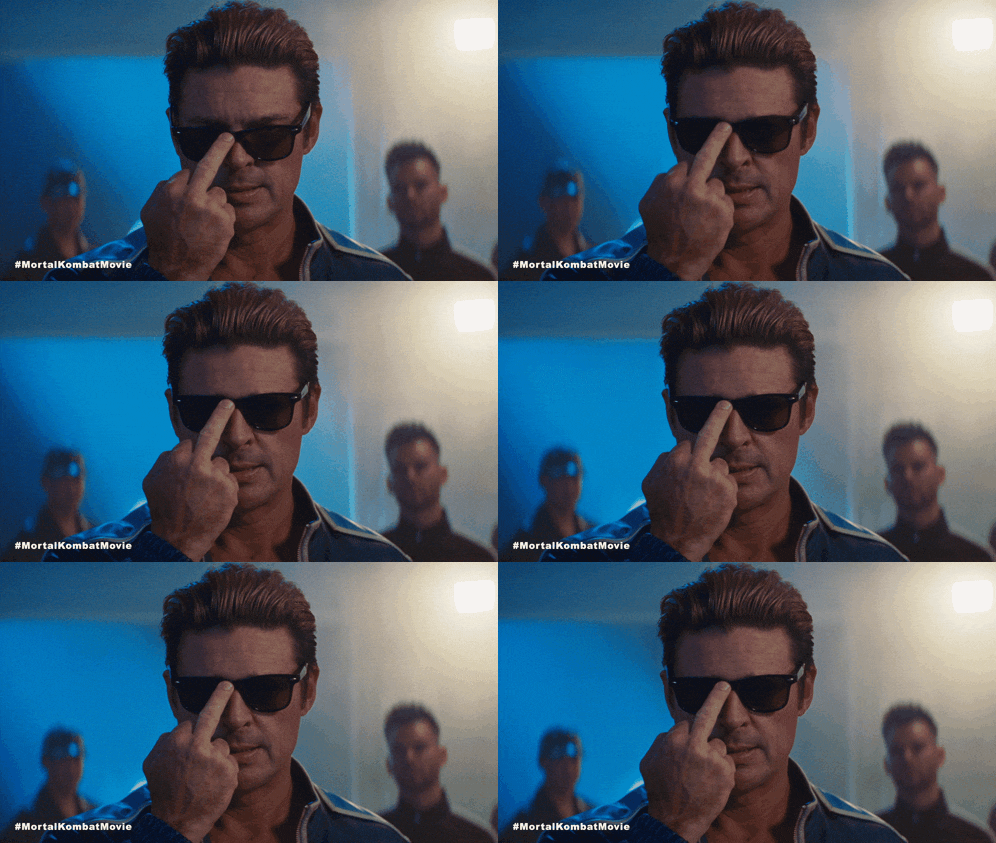
Right, this is the bulk of it. I’ve collected a genuinely stupid number of examples for this campaign, so let me try and group it sensibly…
Fight Fans, Sports Crossovers, and Why This Was Always Going to Work
If you’re marketing a fighting franchise, fight culture environments are basically a free audience match, and Warner Bros. clearly knew this.
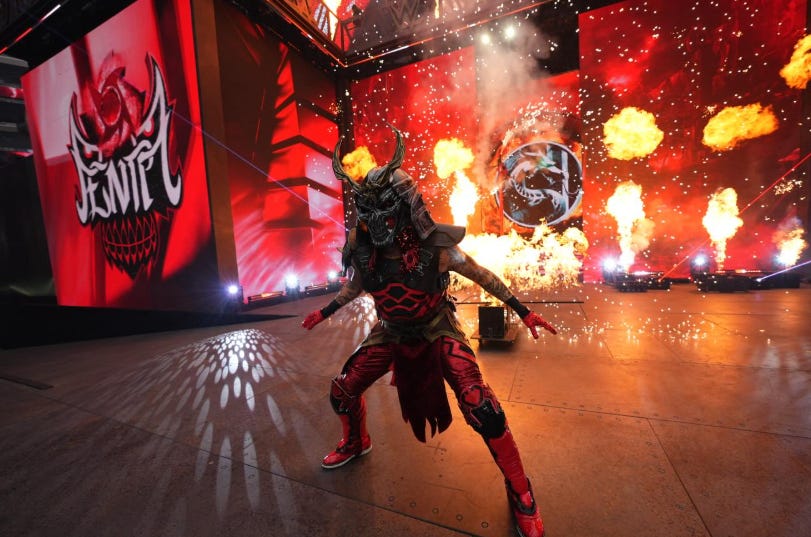
The headline one for me is the WWE. Mortal Kombat 2 heavily partnered with WWE at WrestleMania 42 in April, featuring a major cross-promotion: the MKII logo on the ring canvas, televised promo trailers during commercial breaks, and sponsored merchandise. At the event, WWE superstar Penta delivered a highly memorable, Shao Kahn-inspired entrance where he donned the armour set during his ring walk, before defending his Intercontinental Championship in a six-pack ladder match.
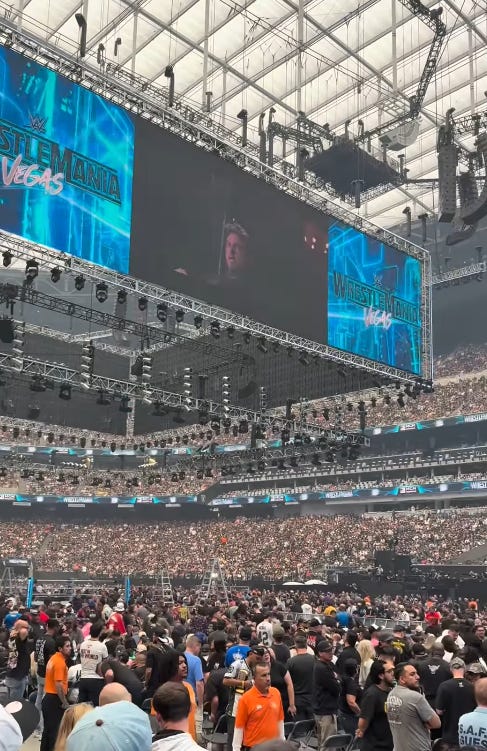
Uncanny Carlos shared a video POV from Wrestlemania Vegas capturing the spot on the jumbotron screens, and I’ll be honest, I’m not a WWE fan myself, I didn’t see any of this outside of researching it, but it hits a very similar strand to the one I was pulling on for the boxing and UFC bits to follow: WWE is for the fight fans, albeit way more performative, but fight fans nonetheless. WWE in itself is a behemoth with its own transmedia storytelling, so adding MK on top is a pretty simple move a lot of other IPs and franchises would’ve done in the past and will continue to do in future.

The video above of Penta’s entrance is basically a costume change scene out of the Arkham games; it opens with him putting on the armour and Shao Khan mask, then walking out to the ring in full character. It’s two minutes long and I genuinely might become a WWE fan now lol because it’s honestly so cool! He’s even shared additional photos to his own Instagram account too, 78k likes and a couple of ‘tough’ aura-filled photos worthy of wall space, even if it was for a film marketing campaign. Someone at WB/MK wanted this to happen and made it work; I absolutely love that for them!
Going back to my point though, that still stands:
Fight fans + fighting-adjacent media = a likely crossover of audiences and appeal, and continued, renewed, or brand new fandom.
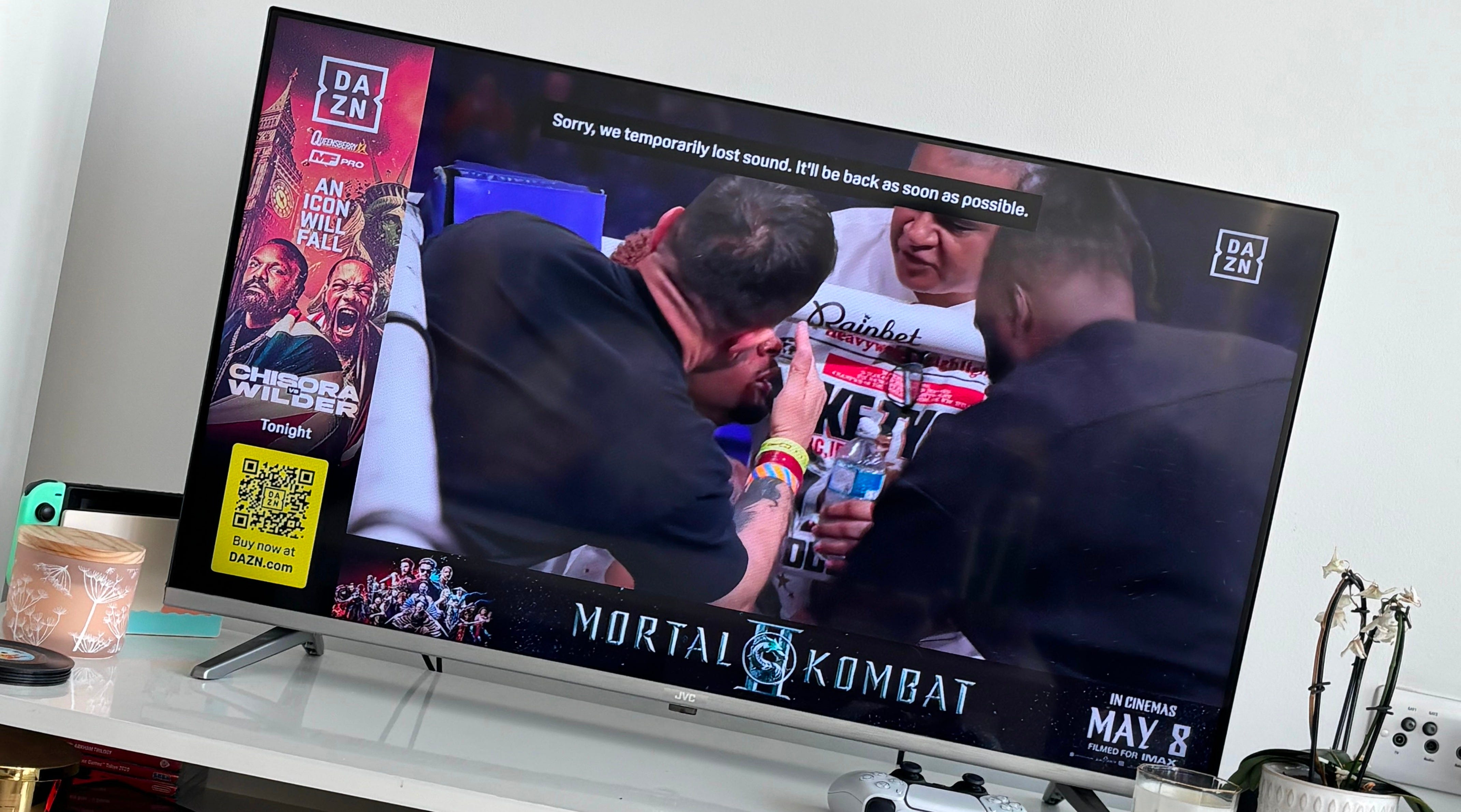
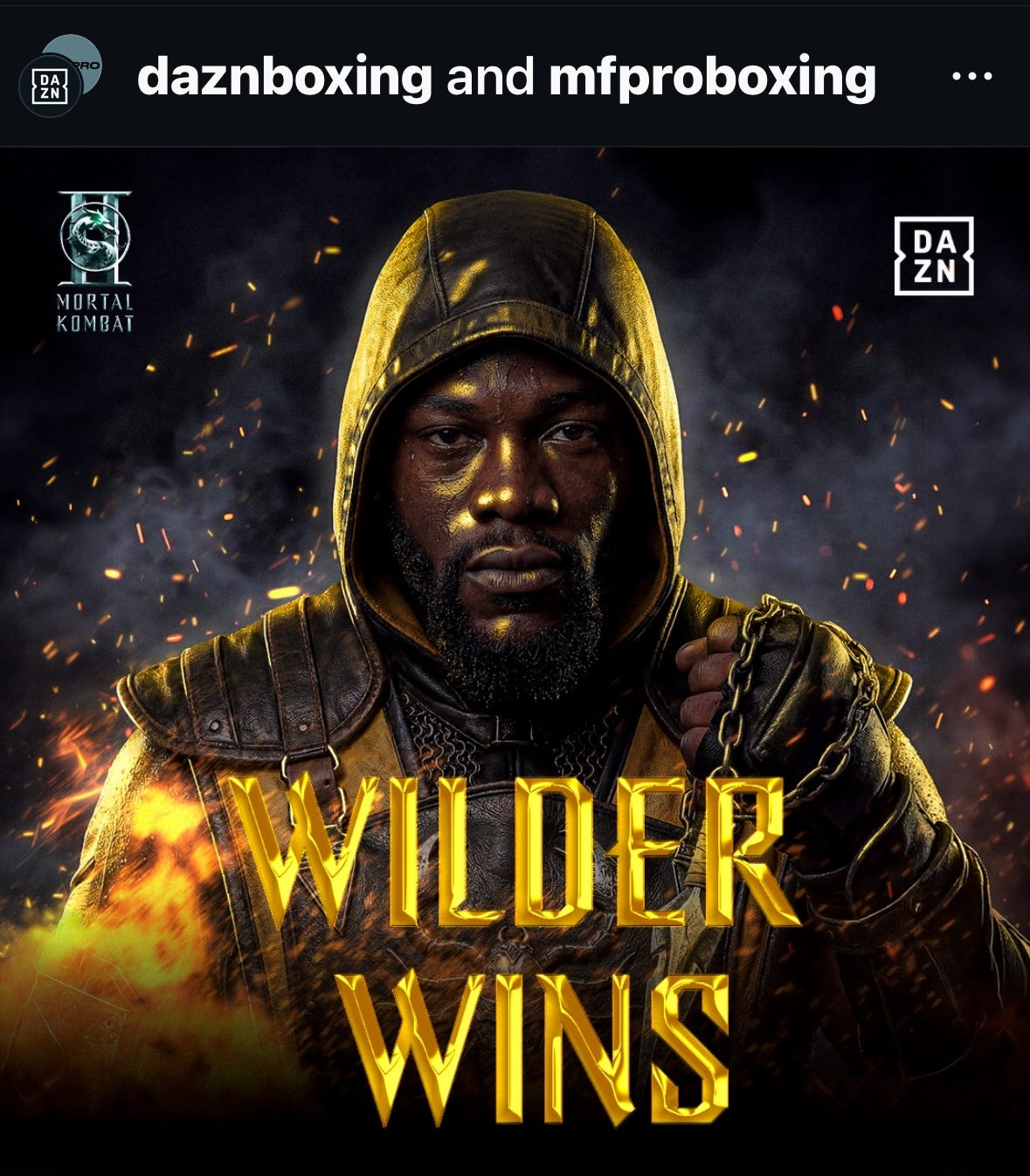
Then there’s boxing, which I partially-caught live; I don’t have a DAZN subscription, but I was watching the Chisora vs Wilder pre-fights on YouTube and could see video banners, ring logos, and what looked like a partnership, because when Wilder won, the image shared to the official DAZN Instagram was of him wearing a Scorpion-inspired outfit plus MK typography reading “Wilder Wins.”
It’s worth saying Warner Bros. does own TNT Sports, so I’m pretty confident they’d have had more sports programming to play across, especially UFC, since that’s the place you can watch it internationally outside the US (where Paramount hold the primary streaming rights). The MKII sports promo itself would’ve been an integrated cross-promotion between Warner Bros. and TNT Sports, aimed towards highlighting Karl Urban’s Johnny Cage stepping up to the plate, blending tournament footage with high-energy sports advertising aesthetics; one example I found even came from the Chile TNT channel, which really backs up the international reach and sports audience targeting.
I shouldn’t have to explain to most why MKII fits so perfectly within martial arts and sports targeting, but for anyone who isn’t sure:
Fighting movie based on fighting game, plus fighting in real life, equals fighting fans who like to see fighting and watch fighting.
You catch my drift?
This doesn’t guarantee an audience on its own of course, you’ve still got to sell the idea that MKII is worth fight fans’ while, but that’s where your fans, your fight scenes, and your iconic characters come in. The reason fight fans like boxing or MMA and the UFC, for example, is because they’re invested in the fighters, their storylines, their skills, and want to see the best against the best. The colosseum exists for this exact same reason and has stood the test of time as a testament to this idea.


While I was searching for UFC and MKII examples, I actually found a brilliant BBC piece from 2022 on How Mortal Kombat helped shape the UFC, and the history is genuinely fascinating. UFC co-creator Campbell McLaren has said the franchise had a real influence on the UFC’s creation. He visualised a real-life version of Mortal Kombat after hearing Rorion Gracie’s idea for a “War of the Worlds” competition, and made the first event look like Mortal Kombat (just without yelling “Finish Him!”).
The octagon itself was also born partly from a suggestion for Greek pillars and columns, which McLaren rejected in favour of a “modern, techie, urban-looking setting” using chain-link fence and a steel gate, specifically chasing that MK look. Even the marketing taglines mirrored each other - “Two Men Enter. One Man Leaves,” “So Real It Hurts” - similar enough that Senator John McCain led a campaign against the UFC shortly after the first event, and the MMA ban in New York wasn’t lifted until 2016.


The roles have since reversed, with MMA now influencing Mortal Kombat. Cole Young from the 2021 film was reportedly based largely on Jorge Masvidal, which is interesting because I genuinely did not get that connection watching it. Fighters like Max Holloway have said they’ve developed more as fighters by playing fight games, and honestly, I get that. Even when I train and do light boxing bag work myself, I’ll find myself moving more fluidly and practising techniques better after playing UFC 5, which has become somewhat a ritual for me. I’ve been a fan of the sport, the fighters, and training for a long time now, but I’m sure like many can relate, I just struggle to remain consistent with it; it would appear, writing things like this is more my style ;)

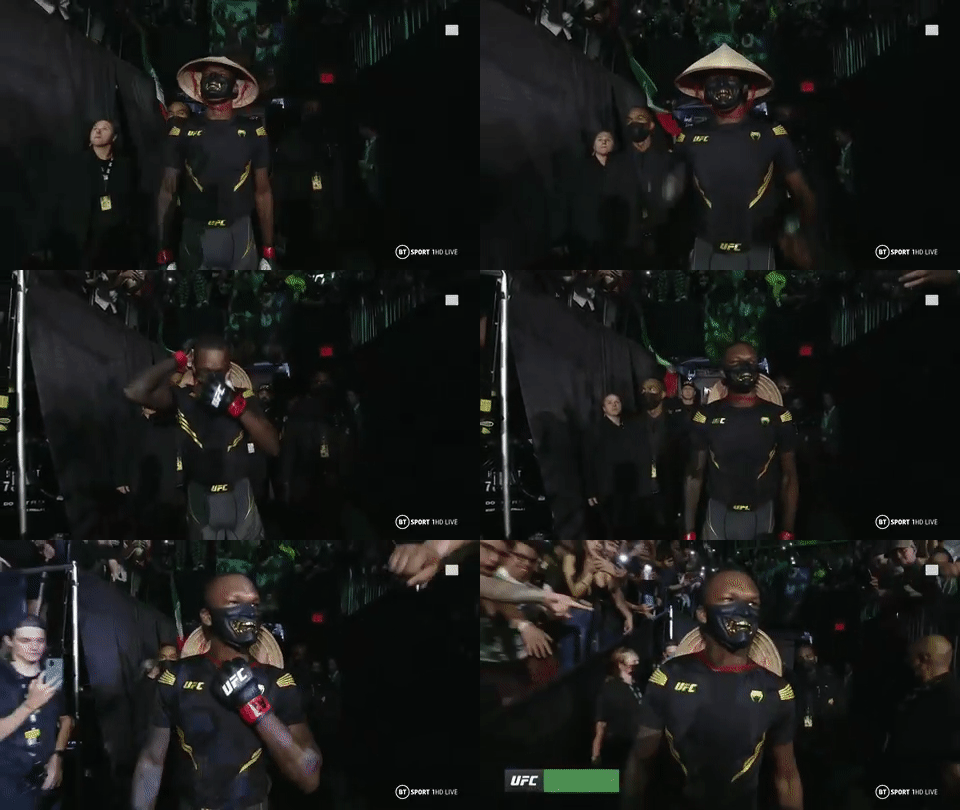
This doesn’t just apply to Mortal Kombat either, mind you. Street Fighter (which I’ll be writing about later this year, keep your inboxes ready) and even anime like Naruto fit the same mould, you only have to look at someone like Israel Adesanya, who’s built half his persona on anime references and walkout entrances, to see fighters borrowing the theatre of it right back. “Fighting as a medium” would be a great study and breakdown in itself, because it truly transcends all media and is, in itself, transmedia. The Greeks, the Olympics, survival and wars, movie stars, sports stars, games, films, manga, comics, all of it.
Which is sort of the point I keep circling back to with Chisora and Wilder too. It’s a great bit of tactical media buying to reach a contextual audience, sure, but it’s so much more than that, and I’m glad DAZN partnered with Warner for Mortal Kombat 2 for that additional step. It’s not just a media buy. Philosophically it’s about fight culture, branding and IP, and tapping into that innate, centuries-old desire for combat. I suppose It’s raw, authentic, and entertainment at its best.
Out-of-Home: From an LED Dragon in LA to a Car Cut in Half in Toronto
Whilst the campaign overall got pretty creative, this is a staple media channel that deserves real creativity and comes with a bunch of examples, so I want to give it proper room.


Starting close to LA; Outfront Media built a Sunset Blvd billboard that, again, I’ve got to say is simple but incredible. Simply put, it’s the giant Mortal Kombat Logo’s Dragon, front and centre, with 3D text above the billboard plus “Only in theatres May 8” to the left with “filmed for IMAX” of course, but it’s the day-to-night variation that makes it stand out. During the day there’s a slight green tinge, mostly around the eye but with some on the silver scales too. At night that green tinge becomes completely visible because those parts are LEDs; the whole dragon is enveloped by a green background LED, the eye pops more, and so does the whole icon. It’s brilliant and a perfect way to make your roadside billboard stand out that little bit more.


Producer Todd Garner and MK co-creator Ed Boon both shared it on their socials too earning additional media coverage; outside of the vast amount of people passing by whom may have also shared photos or videos too!
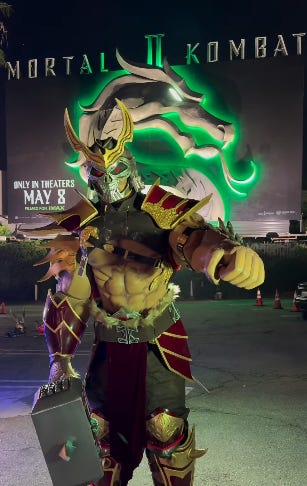
There’s a great fan layer attached to this one too. An Instagram cosplayer called Uncanny Carlos shared a post of himself in front of it dressed as Shao Khan, in a post shared between him, Outfront, Martyn Ford, and an MK fan page called MK Arcade Collection (with both Martyn Ford and Mehcad Brooks commenting; Shao Kahn & Jax) it capitalised on wider awareness from all profiles audiences. Carlos’ bio describes him as a “World traveler. Cosplayer. Kollector.” (’Kollector’ referring to how he collects MK memorabilia, with the franchise’s habit of swapping in a ‘K’ wherever it can), and he’s also an official MK Ambassador; so there’s really no other perfect choice for this post!
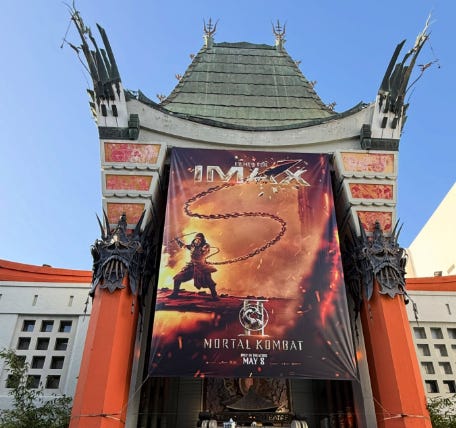
His account is genuinely stacked with other examples too, in fact he was really helpful for that and I owe him props: he attended the premiere as Khan in a photo alongside Boon, Tobias, and Brian Glynn (the original Shao Khan), he somehow managed to bag an actual MK2 theatrical promotional pillar (a 3D rectangular pillar with four character faces, one per side) to keep in his own MK Room, and he also re-attended the TCL Chinese Theatre for an IMAX screening on Mother’s Day with his family; complete with an absolutely massive banner ad promoting the IMAX experience. Honestly just in these examples alone, Mortal Kombat shows me it’s one of those franchise IPs that’s brilliant for Warner, just because it transcends so many mediums and really brings that fighting spirit home!


Then there’s London. Old Brompton Road got two 2D cut-out, backlit billboards from WB and JCDecaux, relying heavily on the fight at hand rather than going lowkey. One side is icy blue, focusing on Kung Lao vs Liu Kang (the best fight outside of Shao Khan vs Cole, for my money), the other fiery red with Kitana vs Johnny Cage. Both have lighting attached so they pop at night too, characters breaking out of the billboard frame entirely.
Outside of these, the wider UK media plan consisted of more OOH; large roadside billboards (towers, digital screens, landscape 96s), and the typical D6 formats you’ll find in the London Underground and bus shelters, these were mostly digital but some of the national/bus formats were paper (if that’s of interest to you), outside of that the creative varied only slightly as the primary key differed depending on the location/format. Then there was also a radio push, though I could only track down one 30-second standard spot, but I must say, the “Get Over Here” quip cut right through me; how can it not, the line is iconic for a reason and bodes well in a audio setting!
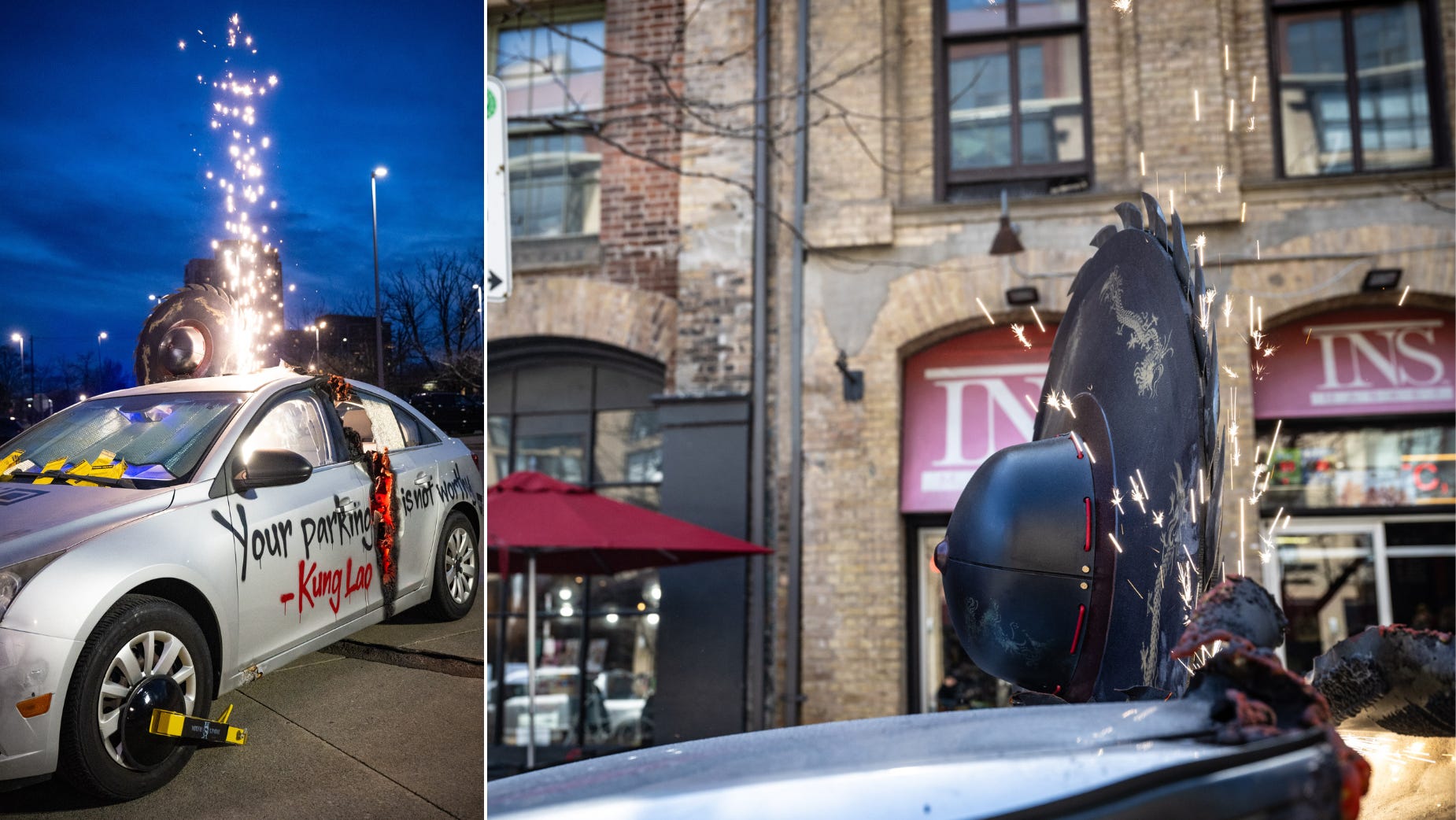
But the one that genuinely stopped me scrolling was Toronto. This is honestly such a completely out-of-the-ordinary piece of experiential work, but it’s just so damn cool: a silver Chevrolet Cruze, cut in half, with a giant QR code on the bonnet (scan for a chance to win $2,500 in prepaid gas cards and movie tickets), various yellow parking tickets stuck to the windscreen, a custom licence plate reading “Earthrealm $HOW1M3” (read it as showtime), and Kung Lao’s bladed hat lodged right between the centre of the roof because the car is split clean down the middle.
It was created by Toronto-based experiential production company WXM Tech on Queen Street West, bringing an Earthrealm aesthetic to the city as a one-off activation. “EARTHREALM” plates, a windscreen buried under parking tickets, “Your parking is not worthy” scrawled on the side, and embedded inside the wreckage, that unmistakable bladed hat, spinning ominously, while Fatboy Slim’s “The Rockafeller Skank” blared from the speaker system; aura-filled activation.
The spinning blade itself was apparently an additional flourish developed during production; WXM pushed the concept further with practical engineering once they latched onto the idea, throwing in ember-glowing LEDs and making the car’s cut edge look like it had lost a fight with a red-hot razor hat. In an increasingly crowded experiential landscape, every detail needs to work both in person and through a smartphone camera, and according to Little Black Book, the activation generated 56 million social media impressions; massive.
In all, I’d suggest brands look to leverage more experiential activations like this. It’s not just cool, it’s storytelling in itself, and that’s exactly what you’re trying to sell at the end of the day. While it’s not exactly transmedia, it could be, and that’s the power it has. A fan could take this exact moment and stunt and go on to whip up a quick mini story in their mind for what Kung Lao was up to; was he mid-battle with another opponent like Shao Khan and he’s left his iconic hat behind?
There’s a lot in this static placement. Given the QR code was already there, with enough production time and money, an AR version of the battle could’ve unfolded right on your screen. The possibilities are quite endless.
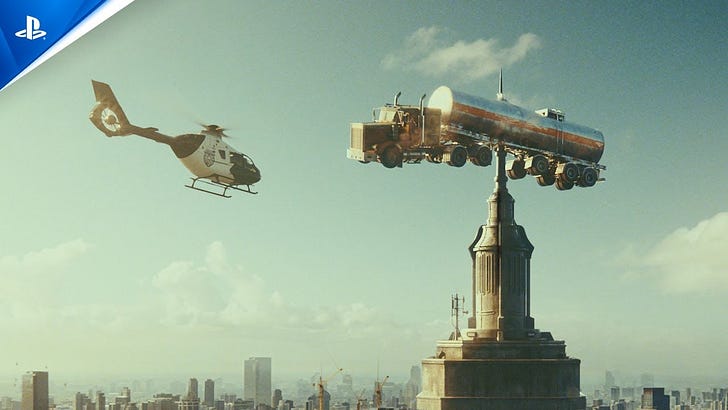
At the start of this year, I wrote a piece on how PlayStation adopted a similar approach but for their global campaign: It Happens on PS5. The campaign brought a mixture of creativity and media buying with the goal of creating unforgettable moments both in the real world and online, you can check that out and save it for later here:
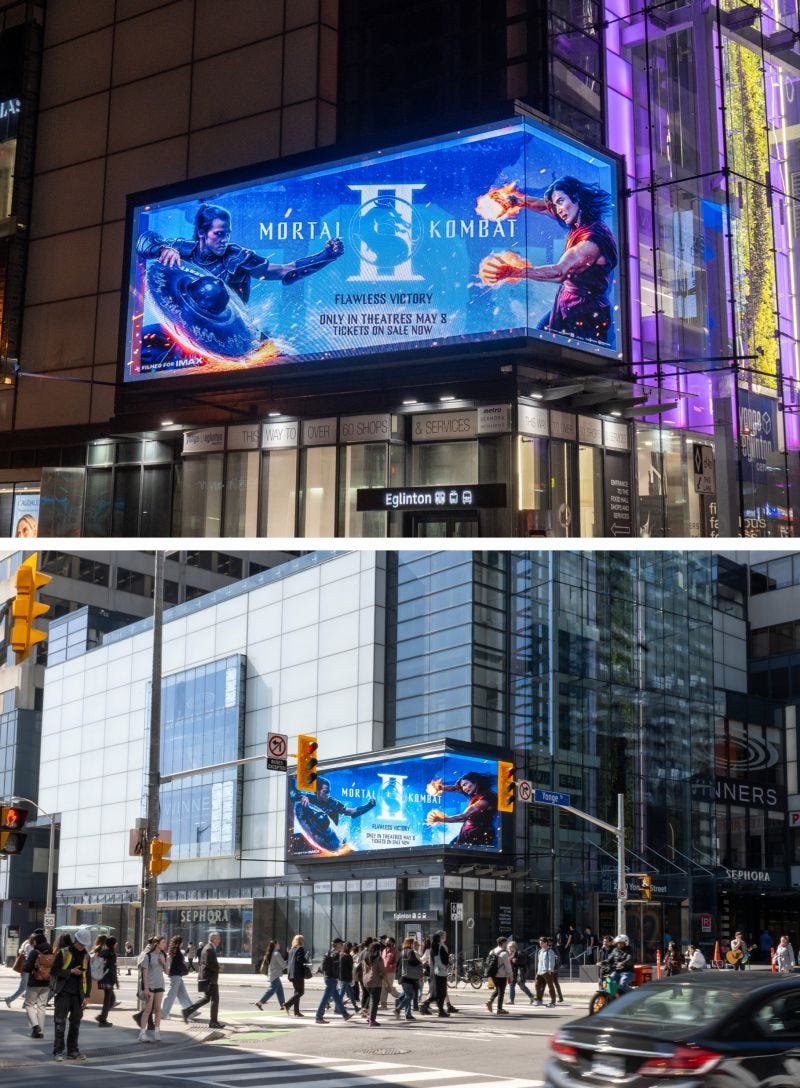
Pair that with a 3D DOOH screen at Yonge-Eglinton Centre in Toronto from Pattison Outdoor, leveraging the same Kung Lao vs Liu Kang key art but giving it a 3D wraparound effect on the building, and you’ve got two pretty heavy placements in Toronto alone.
Conventions and the Global Fan Layer
Looking for a perfect example of how impactful MK actually is as an IP and franchise? Well, the Warner Brazil Instagram account has got you covered with their own content of them at CCXP25. Within, you get to see their pop-up booth - a simple enough setup with the MK logo and release date - for fans in cosplay (and there’s plenty) to take their own photos in.
Alongside that, a gaming section where audiences can be seen actually playing Mortal Kombat is included. There were also character posters and giveaway merch, but as I’ll get into, Mortal Kombat is a deeply fan-centric IP, and it’s clear from the amount of fans in cosplay that they genuinely care and put effort into their fandom. Costumes ranged from the typical and commercially sold costumes, to the far more intricate home-made complete with weapons; even retro-looking skeleton-head Scorpions made an appearance. For the franchise to give back by providing photo ops and a chance to hang with other MK fans is brilliant, and honestly the minimum really.
The gaming section had that proper esports feel too, players in expensive headsets on PS5’s, sat in proper gaming chairs, wearing jerseys with their names on; clearly encouraging that side of the franchise, which is essential to MK’s roots.
For added context, CCXP describe themselves as blending all kinds of pop culture worlds into one epic experience, a place for movie fans, binge-watchers, comic collectors, cosplayers, and everyone in between.
MKII hits that international mark as all franchises should, and it’s great to see LATAM fans and audiences show up and understand the assignment. The same energy showed up at New York Comic Con via the official MK Instagram account too; same context, same passion, just a different convention and a different audience, just to drill home the international point.
Then there’s Max Huang, who plays Kung Lao, at a fan event in Jakarta, showing fans some actual Kung Lao moves.
My thoughts taken as they are from my research: Dude, wtaf! Mortal Kombat and WB need to lean into this more often.
Funny thing is, this isn’t even a post from their official social media accounts, rather it’s from a pop culture adjacent account, Geek Culture. There’s a reason Max is Kung Lao, he just showed it off here, doing his own stunt work and movement, even in a suit and skinny trousers. Epic as f*ck to say the least. Not all stars will adopt this heavy approach to stunt work and choreography of course, but when one does, you should really lean into it when you can.
Making MK2 feel more real and life-like with practical sets, effects, and real stunts is what separates it from just another fight film. One extra tidbit from me: leaning into that for the Home Entertainment windows and mentioning it comes alongside bonus features, would likely excite fans and have them eat up sales for sure. Imagine a scene breakdown without all the glitz and glam, just watching the choreography play out, it’s cool and it shows off real skill; I’d love to check that out personally.
Huang also shared a video from 2019 of himself doing literal cardboard-hat training for the Kung Lao role, 107k likes from what is essentially resurfaced social proof content, showing he’s been working hard at this for 7 years!
Press, Talent, and the Trailer Numbers
Karl Urban as Johnny Cage was clearly positioned as a figurehead for this campaign, with a Late Night with Seth Meyers appearance being one stop on a genuinely global press tour and convention circuit.
I’ll say it again for those of you in the back:
Long gone are the days of relying strictly on star power.
You see, marketing movies has become increasingly multi-faceted, with so many more variables now playing into the overall strategy. And whilst an RDJ might be the figurehead of the MCU, he’s not actually the sole centre of the marketing mechanism and strategy. And although I personally can’t wait to see his version of Doom, the case is that a lot more goes into marketing movies: the IP itself, the trailer, the media channels, other stars and directors, interests in sports for example and so on…
That said, Karl Urban specifically is a slightly different case, because he’s not just star power being borrowed for the campaign, he is the campaign in a few key ways.
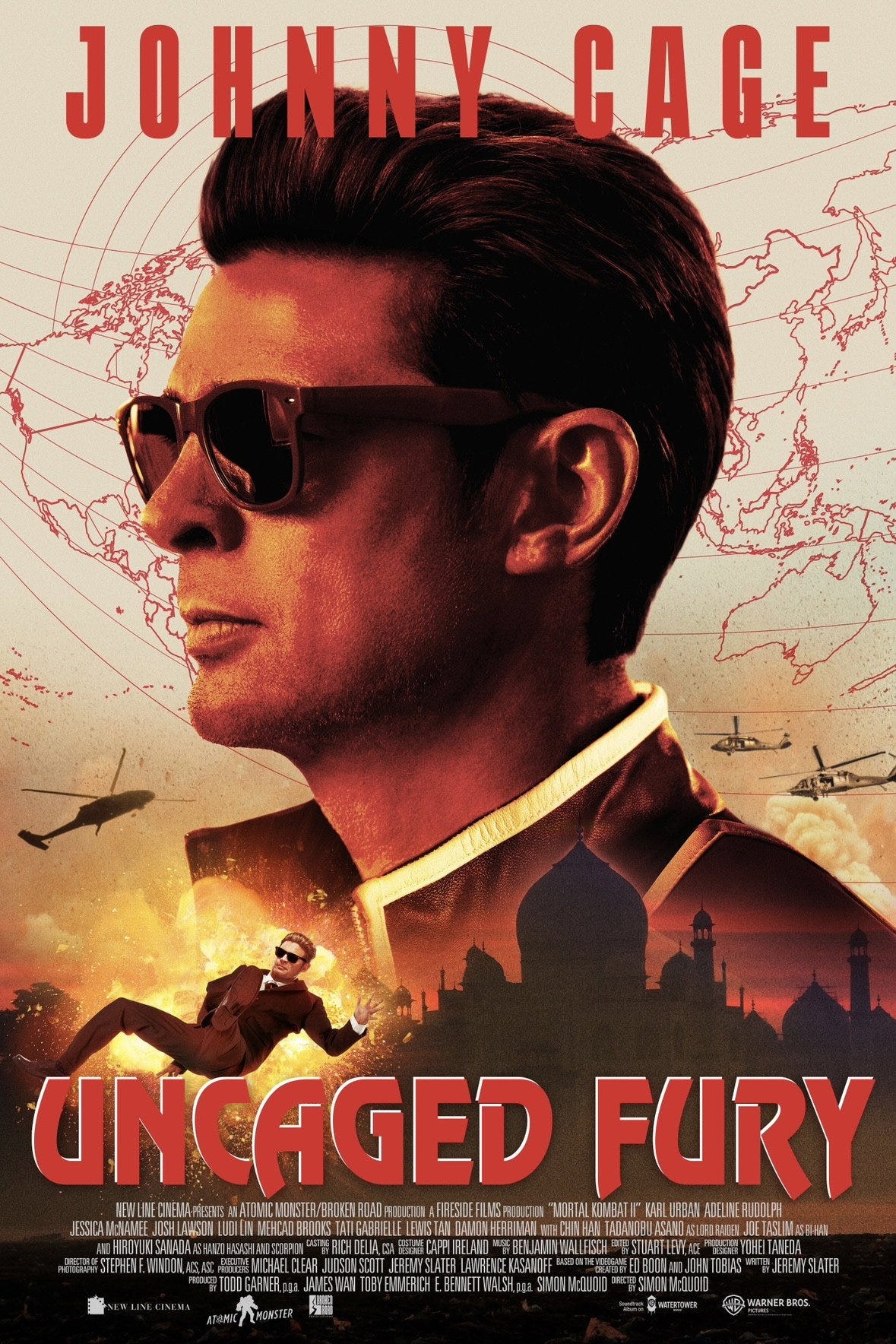
He played Johnny Cage, a pivotal Mortal Kombat character and central to the MKII story, basically a transmedia element on his own. The marketing leant specifically into that in-universe popularity, leveraging his fictionalised film catalogue and highlighting films like “Uncaged Fury” as poster opportunities, the trailer also featured him in key moments, all setting a tone for what to expect of him and his character before you’ve even seen him fight.
That in-universe weight is exactly what the press tour was built to cash in on.
The cast hit fan conventions for organic and earned press, late night slots like Seth, and trailer drops timed to capitalise on the initial buzz, and the numbers back up how well it worked. Screenrant’s coverage of the red-band trailer cites Deadline reporting 106.8 million views in its first 24 hours, breaking the record for the most-viewed red-band trailer ever in that window. I don’t think I have to tell you that’s massive lol!
The YouTube release of that same trailer sits at a more modest 2.5 million views and 90k likes, which makes sense, R-rated content tends to get demonetised and shown less in feeds, so releasing it was more of a creative flex than a reach play, proof to fans that what they’ve come to love about MK is still here.
Compare that to the Official Trailer’s 13 million views and it’s somewhat telling; yet you still need to be over 18 to watch it… Top comments on the Red Band Trailer read as you’d expect: “Scorpion pulling Noob’s shadow-clone out was insane” (9.8k likes), “This looks like a full on Johnny Cage movie and I’m not complaining” (7.9k likes), “It’s a fighting tournament to the death.”
There was also an Instagram post for the rated-R content reading “Allow us to blow your minds. Or your brains off. Whatever comes first,” with slightly lower engagement, though that tracks for content sitting on the more extreme side, the same struggle a lot of horror films face too, which is usually why they end up dayparted around watershed timings to avoid younger audiences.
Social media does already sidestep a chunk of that issue, since it’s less about reaching kids and more about avoiding the algorithm flagging or pulling the content; large studios get round that anyway by having reps preview and okay creative before it goes live. The TV side definitely leant into the same logic properly: a spot for “Mortal Kombat 2 sponsors late nights on Discovery” puts it right alongside Discovery/TLC’s true-crime, bodycam footage and unscripted lifestyle programming; watershed dayparting doing its job while still landing with an audience already engaged in late night and adult themes.
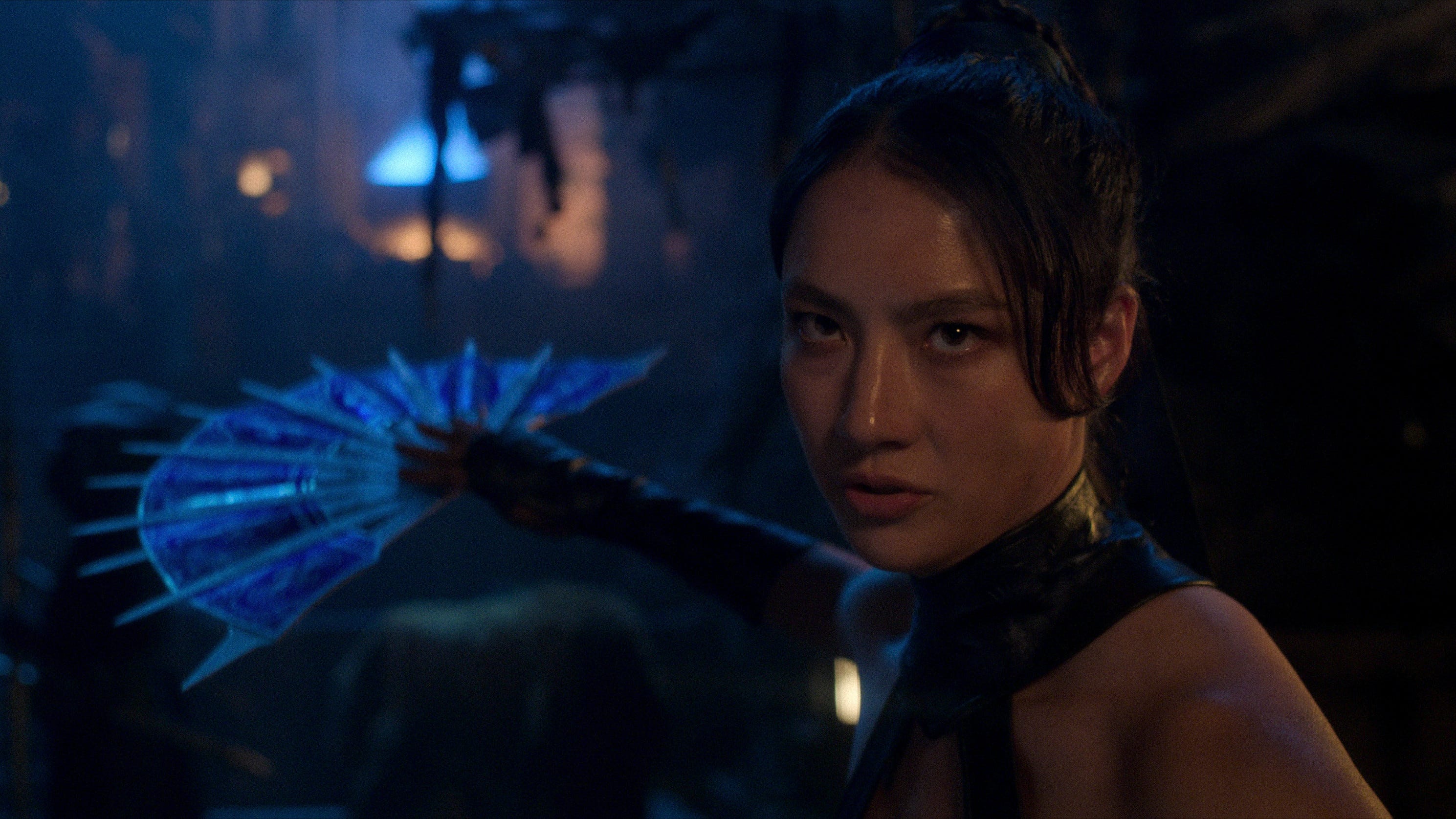
Last one for this section: the Adeline Rudolph (Kitana) interview with The Hollywood Reporter, because there are some genuinely good quotes in there for the transmedia discussion.
On whether the surviving champions deciding to rescue their dead friends from the Netherrealm hints at a third film:
“I genuinely don’t know for certain what is to come. The film alludes to this idea that they are going to bring their lost ones back, so I’d be really excited for that journey. It really opens up a can of worms where anything can happen, and it’s really fun that a death isn’t necessarily a death. We saw Kung Lao come back as a Revenant, as well as Kitana’s mother, Sindel, and Kano. There’s this element of bringing back their souls that I think is really intriguing.” (THR)
And on what she’d want to explore further with Jeremy Slater’s third script in progress:
“There’s so much to pull from, but I do think it would be really interesting to see if we can tie her sisterhood with Mileena back into it. Kitana, Mileena and Jade have such a rich history, and I’d be very open to exploring their complicated relationship.” (THR)
Good little read that whole thing, it’s nice to see the passion and work that goes in behind the scenes from the talent, and great to see the effort to adapt and adopt the franchise’s lore into their own repertoire.
Influencers, “WB Partner,” and “#WBInvited”
Warner Bros. Discovery have clearly built out a structured influencer arm here, consistently tagged with #WBPartner and #WBInvited. A few examples I’ve collected and added to my collection like General Grievous:
Supes (POV: you met the greatest warriors in the universe)
Dont Call Dom (POV: when the announcer yells finish him)
Ashiv_ (pretty cool transitions)
Yuvirayz (found myself in the MK universe).
Separately there’s Just the Nobodys with various content pieces alongside cast members, and Freddy Props attending the US premiere wearing a custom Raiden hat and contact lenses, which is honestly so freaking cool.
Just like most studios, Warner Bros. Discovery typically partners with digital influencers and content creators through bespoke campaigns, affiliate programs, and dedicated advertising networks. Creators are then utilised across their film, gaming, and television IPs to drive engagement, promote upcoming premieres, and boost direct merchandise sales.
Oh, how I love vertical integration and various touchpoints coming together.
And whilst this isn’t particularly new, influencers have worked with brands for a long time, this whole “WBPartner” thing is just a label Warner Bros have introduced to their campaigns and influencer branch to streamline their ‘army ranks’ as I like to put it.
With the first four examples, they all took place in the same setting, you can tell by the neon red and black background, and all start with “#WBPartner” at the beginning of each caption. Where they differ though, is in the creator and their approach. Despite the differences, what is clear to see is the direction of the content because they’re all very similar, representing or holding a character’s weapon, then panning out to see the main cast ensemble with the creator.
The other two examples I linked to are also Instagram influencers, but with very different styles, more akin to their actual content with what looks like less restriction or direction.
Essentially, what WB have done is a great job of manufacturing their own army of influencers who’ve built out a pretty robust library, attached to those various hashtags they’ve built. One click to the hashtag and you’re met with a wide variety of creators and content in relation to WB’s various titles.
Call that: distribution.

Interestingly, after searching for the same hashtag on X, I came across a WWE “WBPartner” post promoting a meet & greet for two of their athletes, a direct link back to my earlier commentary on the WWE crossover, and it comes full circle right here. Glad I caught this one!
Also worth a quick mention: Paddy “The Baddy” shared MK2 content to his Instagram, which initially I thought was so random, but it makes more sense given they’d done a partnership/ad buy with the UFC and the other mixed martial arts I’ve mentioned (boxing and WWE). Paddy’s well known to align himself with paid promo, though he doesn’t overdo it, he’s got official sponsors like Under Armour and Applied Nutrition, but it’s broader examples like this one and Dr Squatch that really catch my eye personally.
It’s simple enough on its own terms though: he’s a macro influencer, so aligning with him taps into the UFC audience and the wider media/partnership buy all at once, reaching a wider UK audience as well as other UFC fans globally, and lining up with interests the target audience is likely to have anyway. It didn’t do massive numbers, 11k likes, but that’s besides the point, it probably delivered a ton of impressions.
My one gripe is that it’s just using the MK2 promo trailer and clips rather than Paddy being more involved in the promo himself. That to me would’ve landed better than a boosted video asset on his profile!
Organic Social and the Fan Layer
I’d be remiss not to include some of the standard social media examples I’ve been stockpiling, organic content to paid ads to wider platform partnerships and extensions.
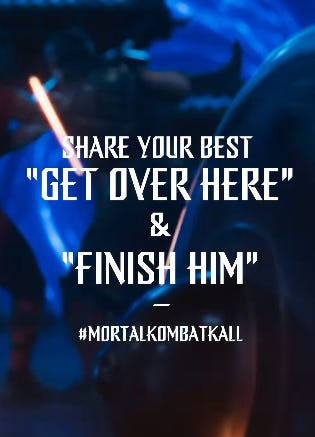
First up, the organic “Get Over Here” trend, which raked in 94k likes on Instagram: “Share your best ‘GET OVER HERE’ or ‘FINISH HIM’ and use #MortalKombatKall. You may just introduce the new Mortal Kombat II trailer on 2/25 at #IGNFanFest.” Great example of using engaging clips from your trailer and press footage to engage core fans, and while I couldn’t find evidence of it actually playing out at IGN Fan Fest, I imagine it did, otherwise it’d be a missed opportunity.
There’s also “My vocal stims for the next 3 months,” 9k likes but still 580 reshares, which is significant for an organic post featuring key audio cues, catchphrases, and sound effects lol. To me this is just a simple example of posting for that day, trial and error, trying a variety of content until you find your winners.
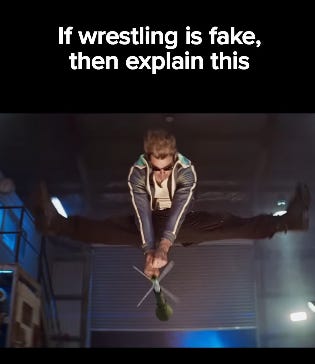
“If wrestling is fake then explain this,” 74k likes, a brilliant use of a key clip of Johnny “performing” and linking it to the age-old commentary around wrestling being fake. Simple, effective, engaging. One commenter was genuinely concerned for a moment, “This gotta be a scene in a set of Johnny making a movie and the acting director will yell cut. Then the main scene continues with Johnny leaving the set and Raiden appears to tell him about Mortal Kombat. God please let this be the case cause if this is a scene from the movie then we are cooked.”
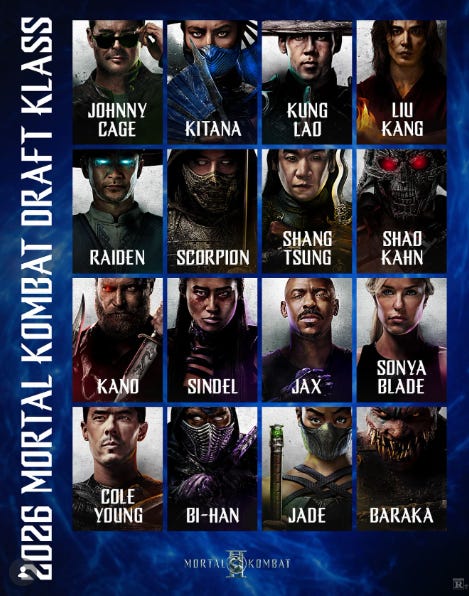
“2026 MK Draft Klass,” posted on the 23rd of April, 44k likes, is a great example of having a social content calendar and aligning organic creative with macro environments and events, timed to NFL Draft season and using character posters as a roster to pick fighters from.
“We expect to see your most lethal fits” is an MK-themed cosplay carousel, 4.1k likes, a great way to spotlight and give back to fans, with some genuinely great content in there including two creators acting out their own version of Jax vs Scorpion.
There’s also a Letterboxd-style repost shared to Instagram of various Mortal Kombat in-universe films, transmedia layer stuff: Cool Hand Cage, Ninja Mime (directed by a fictional Martin Scorsese), Quantum Commando, Citizen Cage, Uncaged Fury, with the rest directed by an Alan Smithee (IYKYK), which is odd because one look at those Letterboxd reviews and they’re essentially near perfect; nothing scored below 4.2.
If we’re being real for a minute, it’s a cool concept and more filmmakers should put effort into developing these kinds of assets where it makes sense, world and story building that is. Johnny Cage is of course notorious for being a movie star in the MK universe, so this makes sense, but other examples where I’ve seen this appear in film rather than marketing material include Running Man with its in-world ads and worldbuilding (the Liquid Death appearance felt so right, I included this in my November watchlist piece), and even Paprika, where Satoshi Kon inserted Easter eggs, references, and visual cameos of his past films within his own work, a frequent doer of that as well.
It’s an extra step, I know, but fans really appreciate it, especially the eagle-eyed and franchise fans. Mortal Kombat especially requires that love and care, and if you wish for your filmography or worlds to hit the same peaks, you must follow suit.
There’s also a “rewatch MK ahead of MKII” post: “Nothing hits like a MORTAL KOMBAT fight scene. Rewatch it ahead of seeing MORTAL KOMBAT II in cinemas May 8.” A given really and somewhat organic drafting, one might say. Like saying, fancy seeing the next show? Watch this beforehand. It’s synergistic and a direct sequel too, so it only makes sense.
Isn’t it perfect that Lauren literally kicks my ass in this example, she has always had a weird knack for Mortal Kombat, and I genuinely get destroyed like that every time…
And then a Snapchat filter that captures your Bitmoji and pits it up against a friend of your choosing, letting you control your fighter and fight as you would in an actual MK game, picking the character you want your Bitmoji to mimic (I went with Shao Khan and Scorpion of course). This was so sick and I feel like it may have been wasted on Snapchat, as it could’ve been used in so many other capacities and platforms.
There’s also a great “what if” buried in here. Two fans showed up dressed as Scorpion and Sub-Zero and staged a fight as the credits rolled, UGC, 49k likes, just two people in matching costumes showing down while everyone watches. If the MK2/WB marketing and PR team were reactive enough, or had the foresight beforehand, they would’ve had a proper story on their hands.
Think Minions: The Rise of Gru and the “Gentleminions” effect, where viral audio sparked a TikTok phenomenon of fans dressing in formal suits to pack cinema screenings, causing a wave of social trends and even temporary theatre bans. This year it looks like Minions & Monsters are aiming to replicate that again, with another partnership with Yeat. This could’ve been replicated with MK2, and could be banked for the future, leaning more into the Lin Kuei potentially, having ninjas hide in theatres to capture phone users (Prince Charles Cinema did this) or staging fights between cosplayers and creators as the credits roll.

It looks like Japan have already cracked that code with their very own Mortal Kombat stage play; the recipe’s there, just kindly ask for it, then lift and shift for a wider audience!


Beyond the organic stuff, there’s also the standard paid YouTube ads that appeared on my CTV/PS5 YouTube app while I was watching or about to watch something, CTV and the big screen at home being essential for all film titles, that’s how you deliver your AV in the best way.
Finally, just chucking this one in here to link back to the social media calendar point I mentioned, but let’s just say someone knows ball…
Cinema Merch and the Popcorn Bucket Economy
It’s 2026 and of course the cinema and popcorn bucket trend doesn’t take any days off, with Mortal Kombat 2 also adding to the conversation with their own. Cinemark’s is a movie slate/clapperboard popcorn bucket with MK2 branding on top, “To my biggest fan. Cage” scribbled on it, and a functional closing clapper lid to store your popcorn. I’d say it’s too skinny and you’d expect to get some additional popcorn lol, but then again it’s better to be less bulky I think, and it’s still somewhat unique and relatable to the film.
Some others like the Galactus head or Jaws shark are pretty epic but otherwise unconventional, this does a decent enough job at both and would be a pretty cool addition to MK “Kollectors’” Kollections.
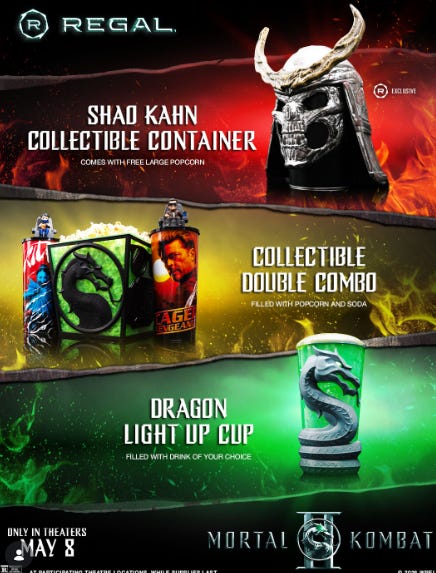
Then there’s the Regal range, kicking off with a Shao Khan Collectible Container that comes with a free large popcorn, epic because it’s literally his film helmet covering a popcorn tin. Sadly I don’t think you can wear it, unless your head is Lego-brick shaped and the size of a baby’s.
They also have a Collectible double combo, a green (jade) and black logo bucket plus two variations of a soda cup, one Kitana themed and one Johnny Cage themed, both with the equivalent character sat in a cinema chair as a topper, pretty cool, and I’d personally rock that bucket if I could for a minimal fee, economic crisis and all that.
Lastly there’s the Dragon Light Up Cup, self-explanatory really and sells itself, the dragon appearing 3D and circling the cup like a snake. There’s also other variations of tins and cups outside of these, but I think these get the most traction online, because if you search MK2 popcorn bucket you’ll mostly see the Shao Khan helmet, though I do believe there’s also a pretty cool 3D arcade machine collectible container too…
Press Coverage and Magazine Real Estate
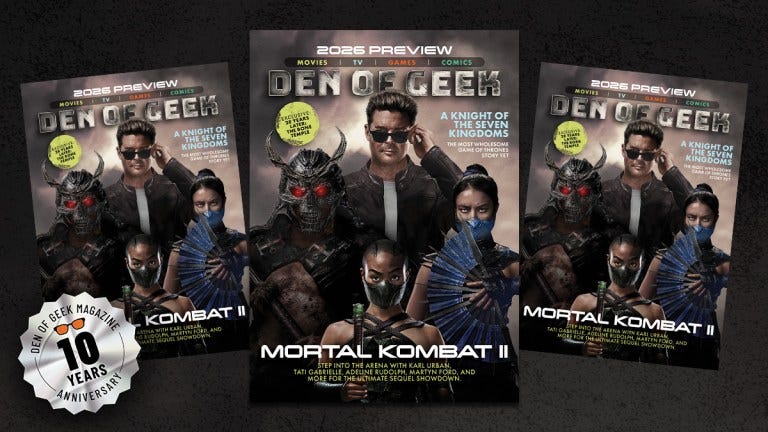
As is the case with most movies, you can expect magazine covers to commemorate the release. This time it’s Den of Geek, a magazine and media owner I’d not particularly heard of till now, but a great addition because, with MKII being both a film and a game adaptation, Den of Geek I imagine is a perfectly audience-aligned media/PR buy. They seem to cover movies, TV, games, and comics, so putting MKII on the front cover for their “MEGA 2026 Preview Issue” aligns both of those audiences nicely.
What Happens After Theatrical: Home Entertainment and the Long Tail
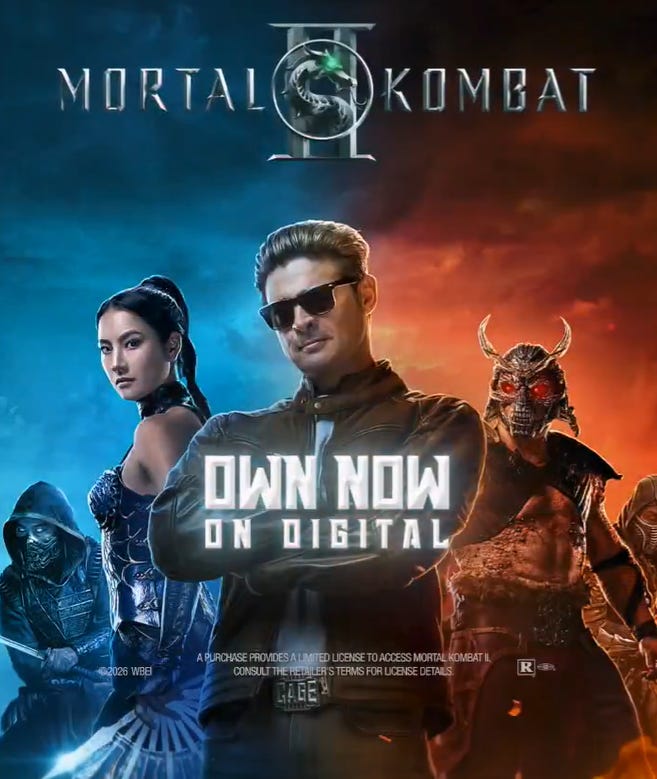
Once theatrical wraps, the ‘Home Ents’ window kicks in, with the buy/rent to watch at home digitally coming first before going to streaming, HBO Max of course. There’ll be limited traditional home entertainment formats you can pick up physically (Blu-ray/4K), with the focus and budget likely going towards digital ownership as traditional media is slowly phased out, though physical releases will still likely be supported by ‘Kollector’s’ editions, fan bundles, and tie-in merch.
I put together a couple examples to capture the Home Ents window; a genuine feat in itself I promise you….
There’s an Instagram post capturing the release “to Digital on June 9th” whilst showcasing how the realms of MKII were built, reading: “From the decaying streets of Edenia to the terrifying Pit featured in the iconic video game series, discover how the Mortal Kombat II design teams blended practical sets with groundbreaking VFX to create the legendary realms in the film!”
This is a great example of bonus content and the USP of buying to own in essence. The fact they’ve highlighted the blend of VFX and practical sets will intrigue many fans - practical sets especially - and any similar BTS content too for that matter.
Whilst the audience interested in this is more niche than the typical fan, it’s an additional interest to account for when it comes to audiences, but generally speaking this isn’t something I’d tend to deep dive into on my own audience analysis or work and would opt to look elsewhere. However, it’s still an additional bonus that should be thought about during production, because fans and buyers do care about it.
Media Play News confirmed the windowing properly:
“New Line Cinema’s Mortal Kombat II will be available for premium digital rental and sale June 9, and on DVD, Blu-ray and 4K Ultra HD disc July 28 from Warner Bros. Discovery Home Entertainment.
Bonus materials on the 4K UHD and Blu-ray include several behind-the-scenes featurettes: “Mortal Kombat II: Evolving the Saga,” about the making of the film; “Building the Realms of Mortal Kombat,” about designing the sets; “Mortal Kombat II: Choose Your Fighter,” about the cast; “Klose Quarters Kombat,” about the stunts and fight scenes; and “A ‘Boon’ to Gamers Everywhere,” a discussion with franchise creator Ed Boon.”
As I previously hinted, something I always find very difficult to find is Home Ents advertising and marketing examples - it’s always a pain - but I do try to find them when I can.

In fact, I did find a social example via Mortal Kombat Mobile on X, which I include more as an example of IP synergy and as the very basic MK2 social advertising; mostly digital heavy as Home Ents tends to see very little budget in comparison to Theatrical and Streaming. Budgets tend to get split to cover all digital bases where possible, social media, YouTube and CTV (LG, Samsung, etc), and then things like Amazon and maybe VOD/OOH/Radio if you’re lucky.
Going back to that synergy part ever so quickly, the above MK Mobile example from X also represents the literal Mortal Kombat game/app you can download and play on your phone. Whilst it’s telling you the movie is out digitally, it serves 2 messages, including a mention of there being an in-game cross-collaboration which saw MK2 skins added for a variety of characters.
Mortal Kombat 1, for example, saw skins for Scorpion, Sub-Zero, Johnny Cage, Kitana, and Shao Khan (side note: I wanna say Sub-Zero came from the first film, as he didn’t show up in MK2 for obvious reasons).
On the mobile game specifically, it looks like they geared content towards a “Season of the Warlord,” focusing on Shao Khan and bringing him into the game with his “devastating axe,” available for a limited time, rare enough for long-term fans and players to want to collect him, turning him into a season commodity to match typical live service games and their season passes to sustain interest and retention; think about Fortnite and the plethora of examples I’ve showcased previously. It’s somewhat low risk and effort, as you can sustain interest in both and combine the awareness of each to maximise the Mortal Kombat gamer/fan’s awareness of the film and encourage them to see it both in cinemas and at home.
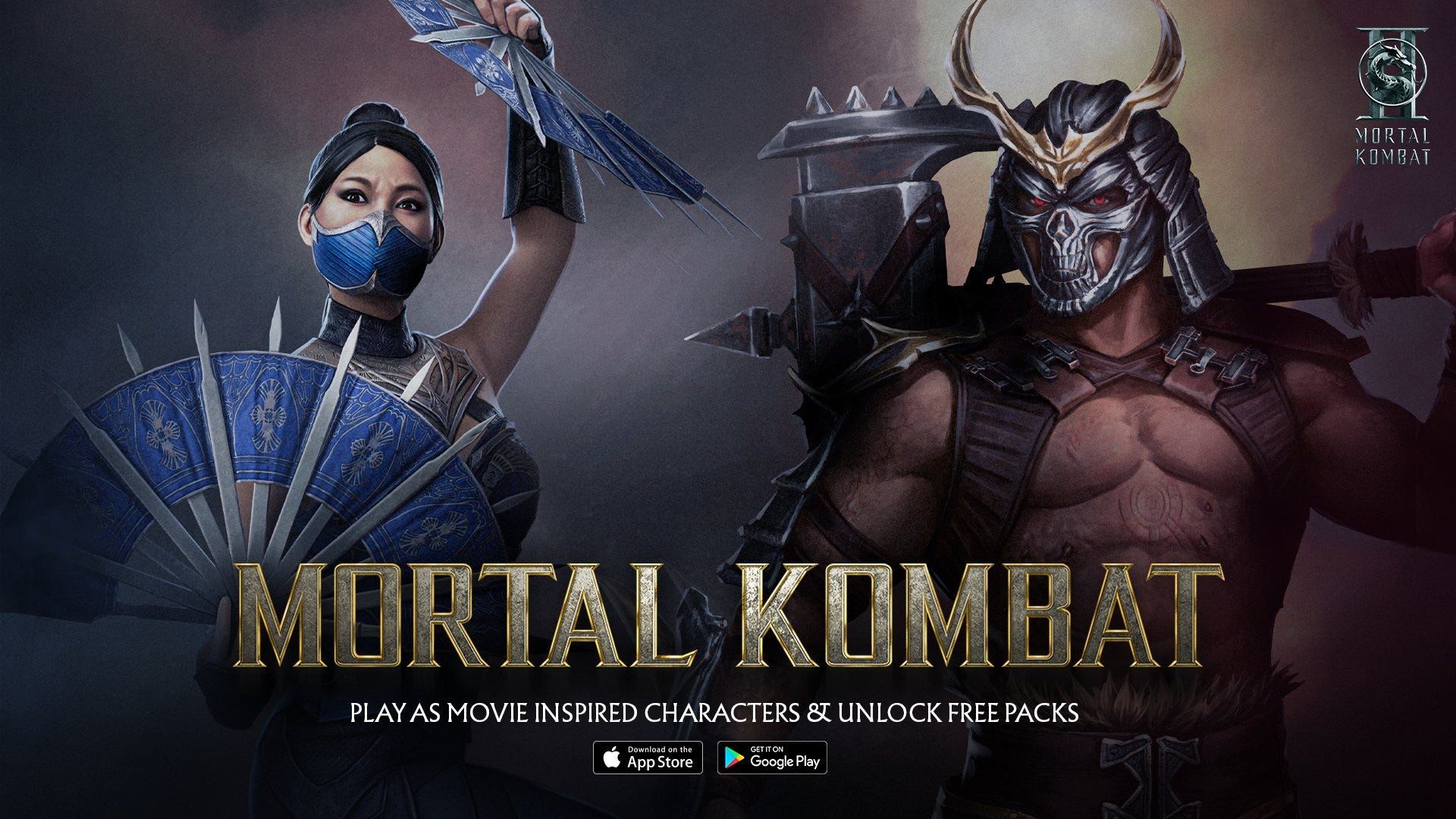
Kitana also got some of the limelight, with her movie-inspired skin making its way into the game too, the post reading: “Kollect Mortal Kombat Movie inspired Kitana and Shao Khan to unleash their cinematic power at your fingertips, and claim 10 FREE movie celebration packs in your inbox.” If that’s not maximising the awareness and synergy of the brand and IP, then I don’t know what is.
The Transmedia Layer: Sound, Synergy, and Where MK Could Actually Go
I want to spend proper time on the sound of this franchise, because I genuinely think it’s the most underrated weapon in MK’s whole arsenal, and most brand universes don’t lean into it nearly as hard as they could.
One thing that’s always been central to Mortal Kombat, and I’d argue most brand universes and 360 IPs, is the music.
Mortal Kombat is no exception, it’s largely known for its iconic soundtracks, sound effects, and various character-specific quips. Call it a sonic profile, the unique auditory character of an object, environment, or brand. It describes how something “sounds” based on its acoustic properties, tone, and texture, and is used across multiple industries including audio engineering, consumer electronics, and corporate branding, for those not in the know.
But what is it that makes the MK soundtrack so iconic?
As the Grammy website puts it:
“In the U.S., high-BPM electronic music rarely broke into mainstream radio or theaters — until the Mortal Kombat soundtrack. Driven by its signature track, “Techno Syndrome,” punctuated by the now-iconic shout of “Mortal Kombat!” the album sold more than a million copies, and peaked in the U.S. at No. 10 on the billboard 200”
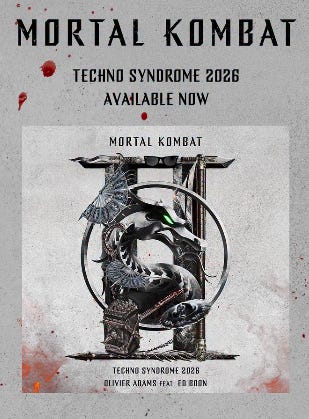
So when WaterTower Music shared to Instagram that “Techno Syndrome 2026 (feat. Ed Boon) is here!”, I’m sure MK fans’ ears pricked up and started listening immediately. Mortal Kombat alone is such an iconic franchise, and for Mortal Kombat 2 to continue leveraging the various assets it has at its disposal is just the tip of the iceberg.
You must be asking yourself at this point, why is music so important to transmedia and brand universes, right?
Well essentially, music is the emotional and cohesive glue of transmedia and brand universes.
You see, sound bypasses conscious analysis to trigger instant feelings, providing a universal, sensory thread that unifies disconnected platforms (films, video games, social media, retail spaces) into a single, immersive storyworld.
Simple right?
Stepping outside Mortal Kombat for a moment, into the realm of K-Pop, MIDiA shares a really insightful piece on why artists need transmedia storytelling. A few tidbits I pulled out and liked from it:
In today’s fragmented marketing world, artists have to promote more than just their music, they have to build dedicated fandom, and more are implementing transmedia elements into their marketing as a result. The most recent example is BTS’s ARIRANG campaign, which connected across Spotify, Instagram, and Google through on-platform fan activities like scavenger hunts and trivia.
Warner Music Group has signed an exclusive deal with Netflix to develop artist documentaries, while HYBE and Spotify have partnered on K-pop video podcasts.
A multi-platform strategy doesn’t mean “be everywhere, all the time.”
As fandom becomes more important, artists now need to think more like an online creator than simply a musician, building audiences across platforms, identity now being the centre rather than the music alone.
It’s in the details for the franchise.
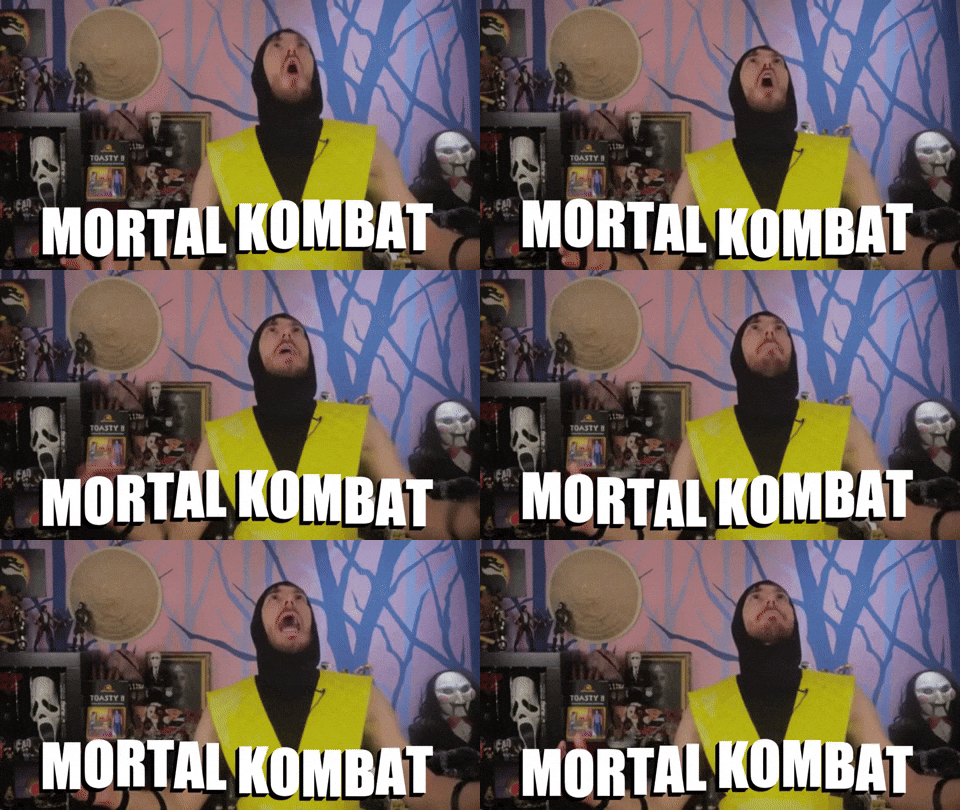
For over three decades, the MK IP has possessed one of the most powerful auditory assets in entertainment history. When modern audiences think of the franchise, they don’t just picture blood and Fatalities, they hear the iconic “MORTAL KOMBAT!” yell and the driving electronic synth line.
And it’s in the strategy for the holding company too. As the parent of NetherRealm Studios (the game developers) and New Line Cinema/WaterTower Music (the film and music arms), Warner Bros. sits on a fully integrated pipeline, able to activate cross-platform continuity through several high-utility strategies. Whilst you certainly wouldn’t think too heavily on the music and audio, it’s actually the most effective and transmutable part of the franchise and IP. The ultimate goal of transmedia branding is to make an IP relevant outside its native format, and music is the most flexible tool for real-world and digital lifestyle immersion.
‘Kombining’ all of this together, you end up getting things like:
Synergy, in-game and with the music ecosystem, “movie packs” releasing in-game alongside the new audio, customised character playlists popping up on Apple Music or Spotify to push distribution
Physical multipliers, specialty labels creating coloured vinyls, Scorpion flame-orange and so on
Sports & live events, Techno Syndrome basically functioning as an anthem, playable during sports highlights and broadcasts as a catchy jingle or sonic logo, playing on the subconscious mind
UGC dominance, trending audio and snippets for short-form content, “Test Your Might” in the backdrop of gaming, fitness, or content creators doing extraordinary things
Experiential, theme parks, VR experiences, attractions and pop-ups, soundscapes ensuring narrative transitions and letting fans step into Outworld environments
There’s a lot you can really do with music and audio, especially when it’s considered a key component of your brand universe and synergy map. I’d encourage you to think on this more when you’re working on your own films, IP, and music.
Where the Mortal Kombat Cinematic Universe Could Go Next
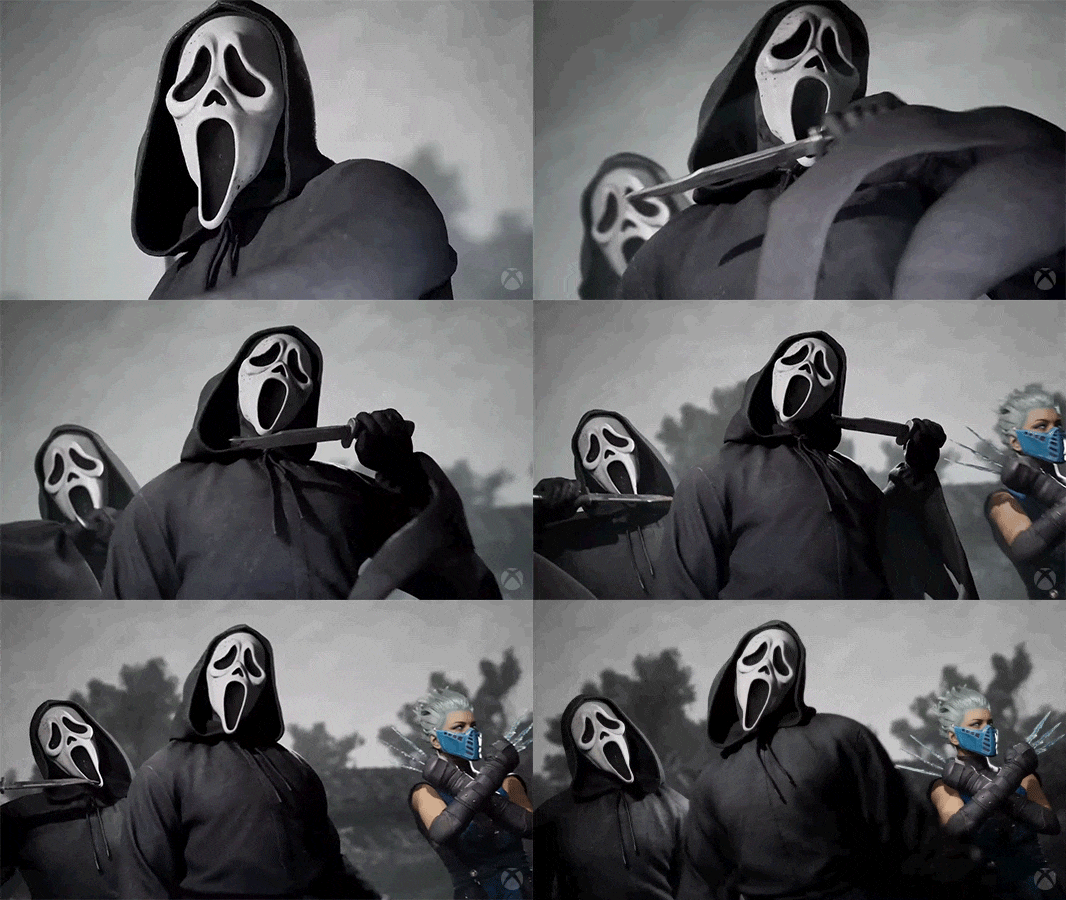
Honestly, not much to add on top of everything above in terms of what’s already happened, but what I could add is where the Mortal Kombat “cinematic universe” could expand from here.
Television & streaming.
We’ve already seen Japan prove an extension format like this can work, with their own MK stage play, so there’s clearly appetite for the lore living somewhere other than a two-hour film. A high-budget, top-notch episodic series could allow the franchise’s lore to breathe, giving more space to flesh out storylines and characters where the films feel rushed and action-packed.
Two examples of what they could do: a Lin Kuei Chronicles live-action prequel series tracing the origins of Sub-Zero (Bi-Han) and Scorpion (Hanzo Hasashi), which co-creator Ed Boon and actor Joe Taslim have already publicly discussed; or an Outworld Political Drama, a Game of Thrones-style thriller tracking the centuries-long conflict between Shao Kahn, King Jerrod, and the eventual annexation of Edenia, naturally fleshing out Kitana, Jade, and Sindel away from a strict tournament structure.
Genre-diversified video games.
While the mainline games continue as NetherRealm works on them for the core fans, the IP could branch into other genres to capture completely new demographics.
An action-RPG/beat ‘em up revival, a modern spiritual successor to Mortal Kombat: Shaolin Monks, following Fire God Liu Kang and Kung Lao exploring different realms, would tap into the mainstream action-adventure market.
A Soulslike Netherrealm adventure, a dark, punishing single-player game starring Scorpion or a resurrected Noob Saibot navigating the horrific depths of the Netherrealm, would be a different swing entirely; Ninja Gaiden comes to mind.
Expanded animation universe.
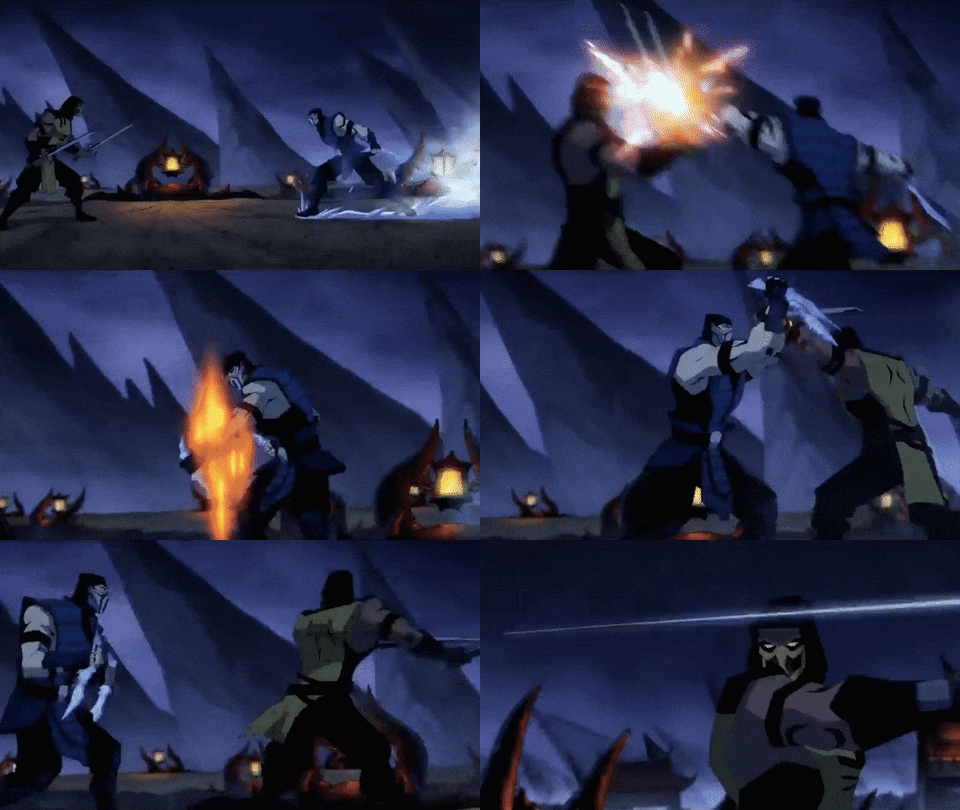
The Mortal Kombat Legends animated films (Scorpion’s Revenge, Battle of the Realms) proved R-rated animation perfectly matches the game’s signature brutality.
An anthology series format, like Love, Death & Robots or Arcane, could explore a different realm each episode (the technological horror of the Cyber Lin Kuei initiative, or the lawless wasteland of the Chaosrealm).
Anime-style spin-offs, partnering with international animation powerhouses like Studio Mir, could produce a long-form series focused on the younger generation of fighters, Cassie Cage and Jacqui Briggs.
Publishing.
Comic books are essentially the glue for transmedia world building, historically, acting as a low-cost, high-yield bridge between game releases.
Canon graphic novels, replicating the success of the Mortal Kombat X comic series by publishing canonical prequels explaining status quo shifts between games and movies.
Lore compendiums, dark-fantasy novels focusing on the mythos of the Elder Gods, the creation of the Kamidogu, and the ancient tournaments.
Wrapping Up
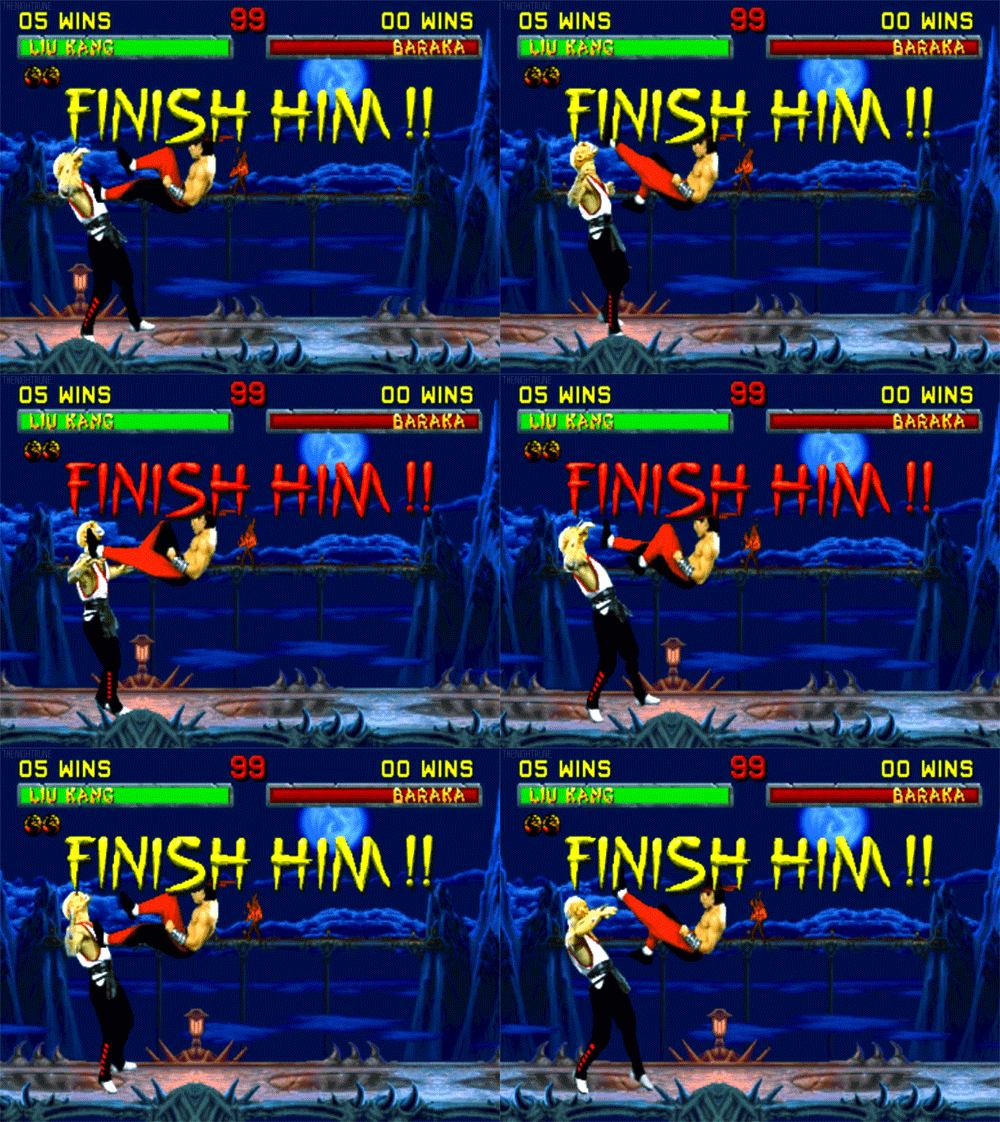
So, pulling all of this together, what actually stands out to me from putting this one together?
Honestly, it’s how much of this campaign worked because the IP itself is built to be picked up and run with, not because WB reinvented anything. The realm system gives creators a built-in excuse to go anywhere, the characters are archetypal enough to survive a jump from arcade cabinet to WrestleMania ring without losing themselves, and the sound design alone has been doing brand recognition work since before half of this audience was born; including myself. WB didn’t have to manufacture a transmedia engine for MKII, it just had to actually use the one Boon and co built thirty-odd years ago. A lot of franchises would kill for that kind of head start, and most don’t use it half as well as MK has here.
What I kept noticing though, section after section, was how often the campaign stopped one step short. The Toronto car, the LinkedIn-style satire energy I’d love to see leant into more, the Snapchat filter that could’ve lived on three other platforms, Max Huang doing real stunt work that should be a Home Ents bonus feature and isn’t yet, as far as I can tell.
None of these are failures exactly, they’re just open doors. And weirdly, I think that’s actually a good sign for the franchise rather than a bad one, because it means there’s clear runway left if WB wants to take it. The fans are already doing unpaid worldbuilding in the gaps (the Letterboxd in-universe films bit is still one of my favourite things I found researching this), which usually means the appetite is there long before the studio catches up to it.
If I had to bet on what happens next, I think it comes down to whether WB treats this as a movie franchise that occasionally does cool marketing, or actually builds the cinematic universe properly; television, games, comics, the lot, the way DC is retrying to do with Gunn now at the helm.
Mortal Kombat has the lore, the sound, and now apparently the box office to support it. What it hasn’t quite had yet is the studio fully committing to “stories become worlds” rather than “stories become sequels.” That’s the gap I’ll be watching for with whatever comes next!
That’s The Harperverse breakdown of Mortal Kombat 2.
If this kind of breakdown is your thing - film marketing, transmedia storytelling, the business behind the stories - subscribe to The Harperverse.
The Harpeverse is a free publication, if you want to support what I’m building here, a paid subscription is £4 a month, less than a coffee in London!
For related reading: Backrooms • Predator: Badlands • From Screens to Space • Bring Her Back • PlayStation, Play, and the Long Game • DareDevil: Born Again • Lee Cronin’s The Mummy
~ most uncredited images will have been taken from the films TMDB page!
Those crossovers are really cool