

Shrek at 25
The Ogre That Ate the Internet (and Refused to Leave)

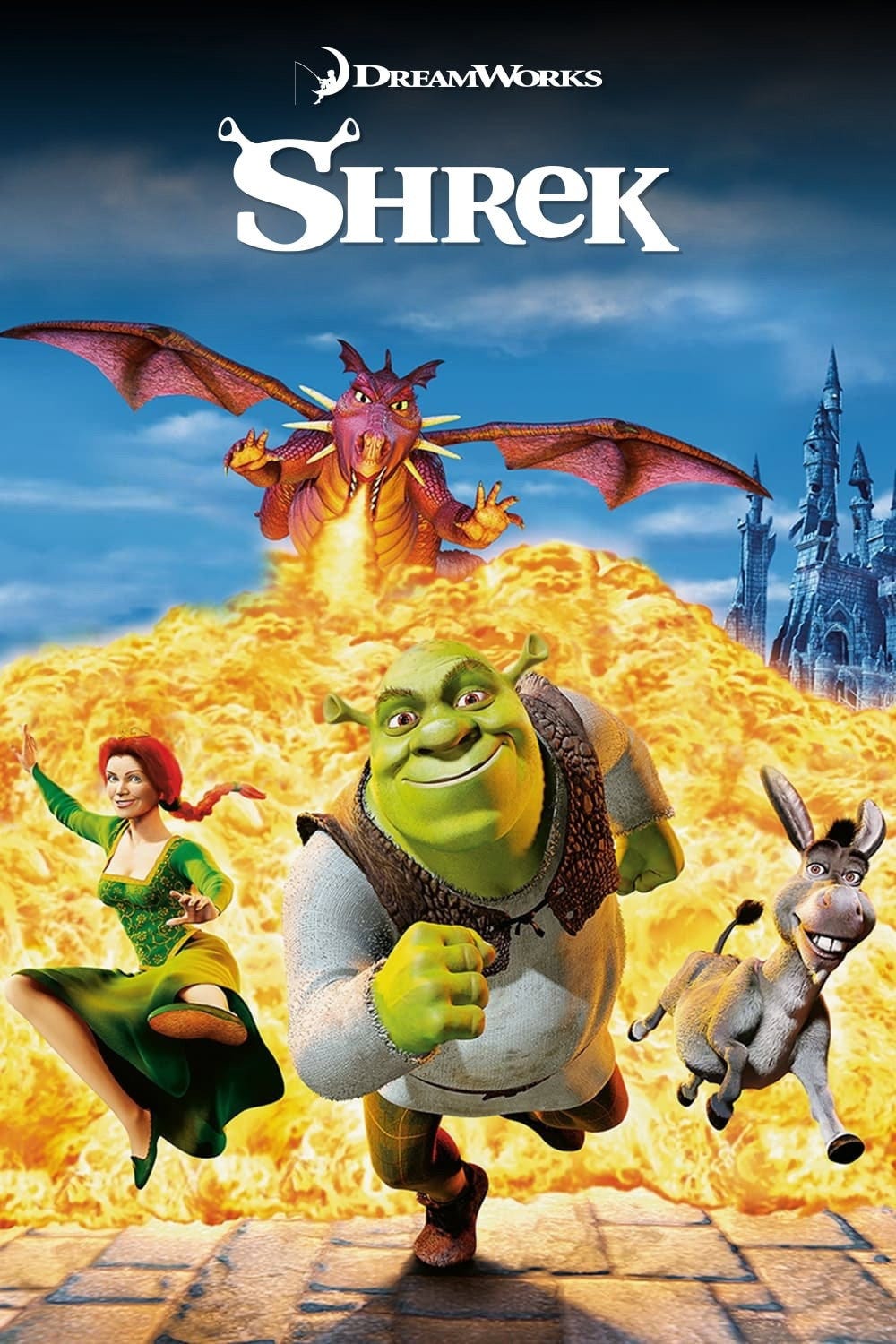
Twenty-five years ago, DreamWorks released an animated film about an antisocial green ogre who just wanted everyone to get off his lawn.
That film went on to win the first-ever Academy Award for Best Animated Feature, spawn one of animation’s most beloved franchises that has grossed nearly $4 billion worldwide, and then - perhaps most remarkably of all - become one of the most durable, genuinely strange, and weirdly powerful pieces of IP on the internet.
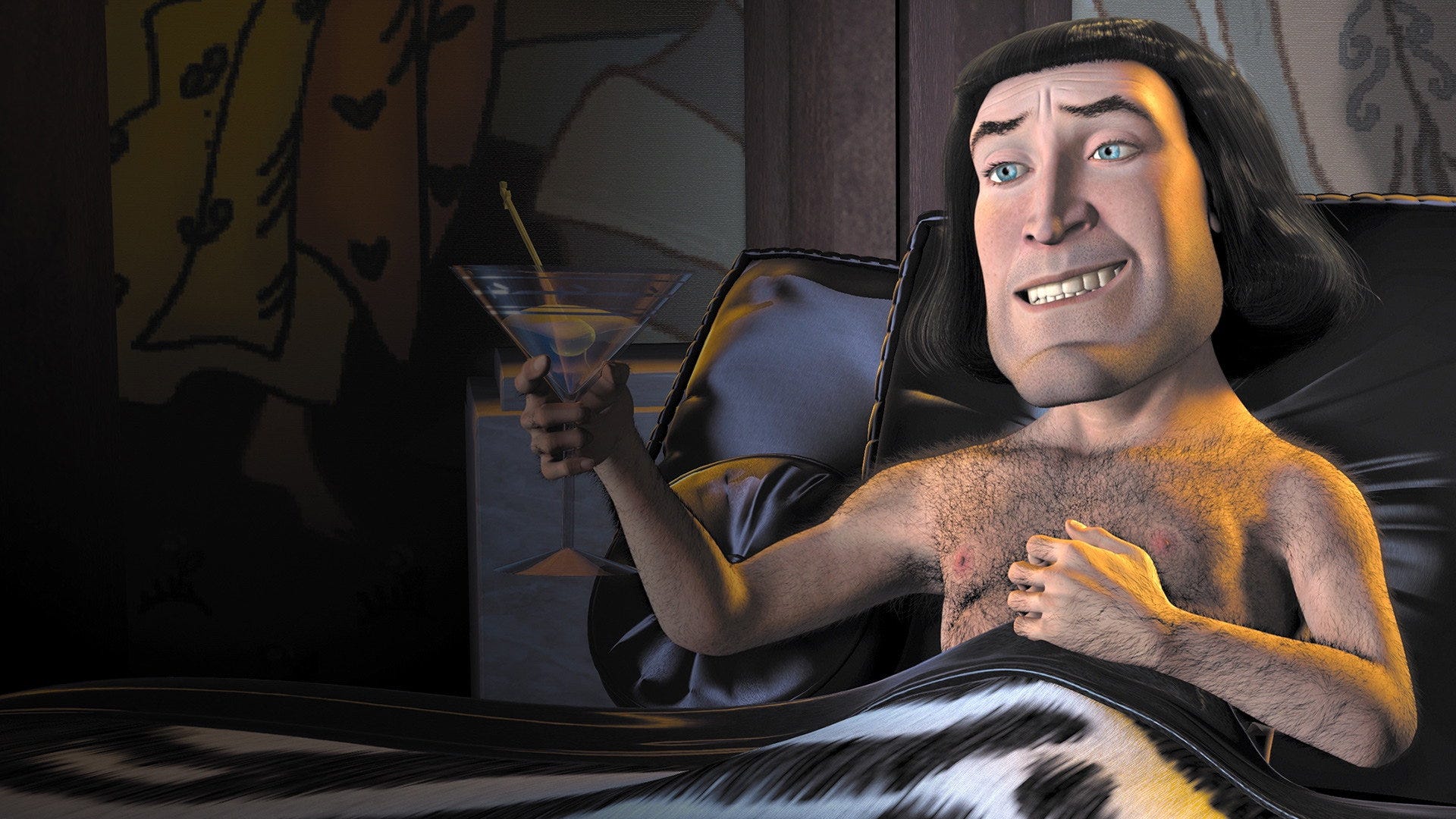
I rewatched Shrek this week in honour of the anniversary, and my Letterboxd review basically writes itself: it’s hilarious, the character chemistry is unreal, and it holds up in a way that a lot of its contemporaries simply don’t. But beyond how good the film is, what I want to dig into today is how DreamWorks actually sold it in 2001, how the franchise turned into a full transmedia universe across two-plus decades, and what the 25th anniversary campaign tells us about where Shrek sits in the culture right now; it’s genuinely fascinating.
Grab your parfait. This one has layers.
How DreamWorks Actually Sold Shrek in 2001
Here’s the thing about the original Shrek campaign that doesn’t get talked about enough: it was genuinely ambitious for its time, and a lot of the tactics feel surprisingly modern in hindsight.
The press campaign played the Hollywood game impeccably. Mike Myers, Eddie Murphy, and Cameron Diaz appeared together at the 14th Annual Nickelodeon Kids’ Choice Awards in April 2001; perfectly timed, family-audience-first, with the film dropping just weeks later. Myers also did the full press circuit, and watching those interviews back is a bit of a time capsule. Just him being Mike Myers, doing the accent, charming everyone. It worked.
But the more interesting stuff happened in the brand partnerships. DreamWorks got Shrek and Donkey to actually appear in the ads themselves, which sounds obvious but is actually pretty rare even now. The Heinz EZ Squirt ketchup collab - yep, green ketchup - had both characters in the ad, integrating them into the product world rather than just slapping a logo on a bottle.
The Baskin-Robbins spot did the same thing with Donkey turning up to eat from their cups. There’s also a Honey Nut Cheerios cereal tie-in from the same period. It’s exactly the kind of work I was writing about in my Beyond the Trailer post; going the extra mile to make sure the characters feel alive in the ad itself, not just wallpaper on someone else’s product.
Then there’s the 2001 Cartoon Network spot, airing alongside the Looney Tunes Fairytale special, reaching both the kids watching Saturday morning TV and the parents sitting on the sofa next to them. Classic dual-audience thinking that animation has always done well.
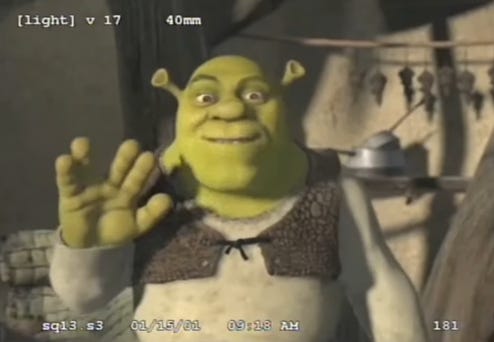
Where things get genuinely cool though is the in-universe/real-world crossover stuff. There’s a Demo Reel from 2001 where Shrek essentially appears as a character in his own right, somewhat breaking the fourth wall; a concept that would feel extremely at home on social media today, but was a real creative swing back then.
And then in 2004, during the Shrek 2 promotional cycle, Barbara Walters famously interviewed Shrek himself; a live-action journalist talking to an animated character on a serious Oscar special. It was groundbreaking. As someone pointed out in the comments: “I miss when movies did stuff like this.” And they’re not wrong, we do still occasionally see this kind of thing (Venom 3 had some moments, which I covered in a previous post), but it’s become the exception rather than the rule.
The crowning moment of the original era though? Shrek and Donkey at the 74th Academy Awards in 2002, when the film won Best Animated Feature. Because Academy rules at the time stated only real people could accept awards on stage, producer Aron Warner collected the statuette; the animated duo were edited into the audience via CGI, sitting alongside real celebrities, reacting to the win in real time. Nathan Lane, who presented the category, told them to “please, be animated.” DreamWorks then leveraged the moment immediately with a celebratory TV spot encouraging people to buy the film on video and DVD. The loop from cultural moment to commerce, closed instantly.
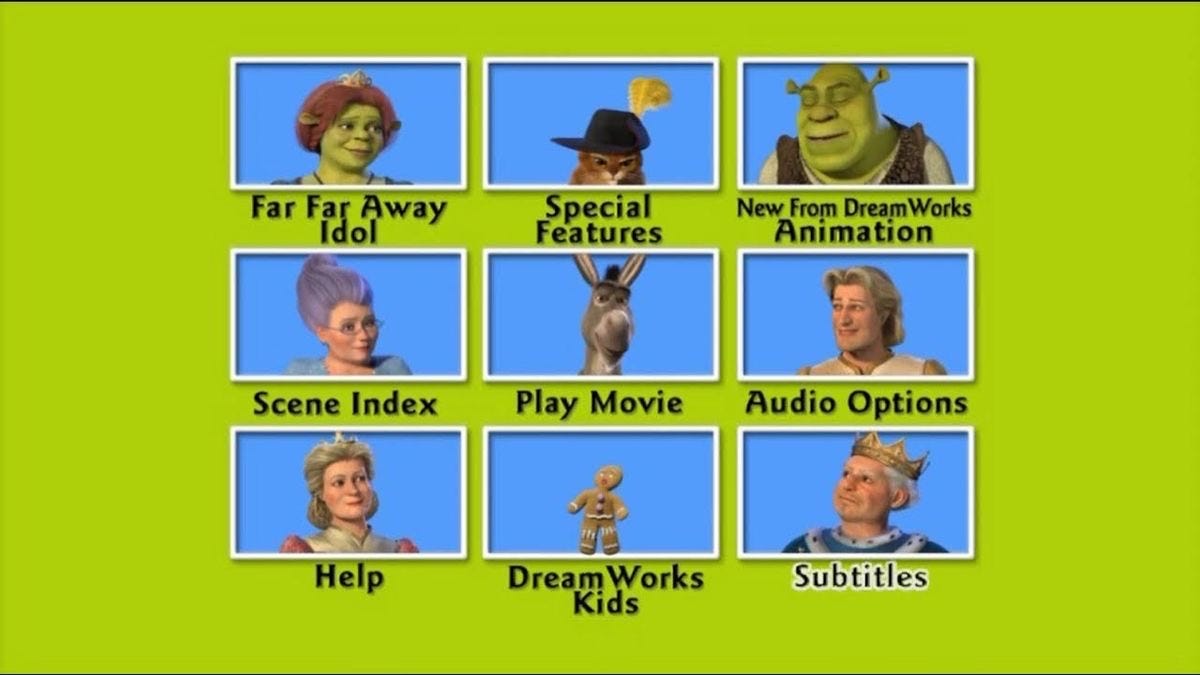
Speaking of which, the original Shrek DVD and Shrek 2 DVD menu are genuinely worth looking at as artefacts of what home entertainment used to offer. Interactive menus, characters talking to each other, bonus content that felt like a reward. Compare that to a Disney+ thumbnail and something has definitely been lost. There was a promotional TV spot for the DVD release too - “#1 selling DVD, don’t miss out!” - which is kind of bittersweet to watch now, knowing how quickly that format got phased out.
The Shrekiverse
What the Franchise Actually Built
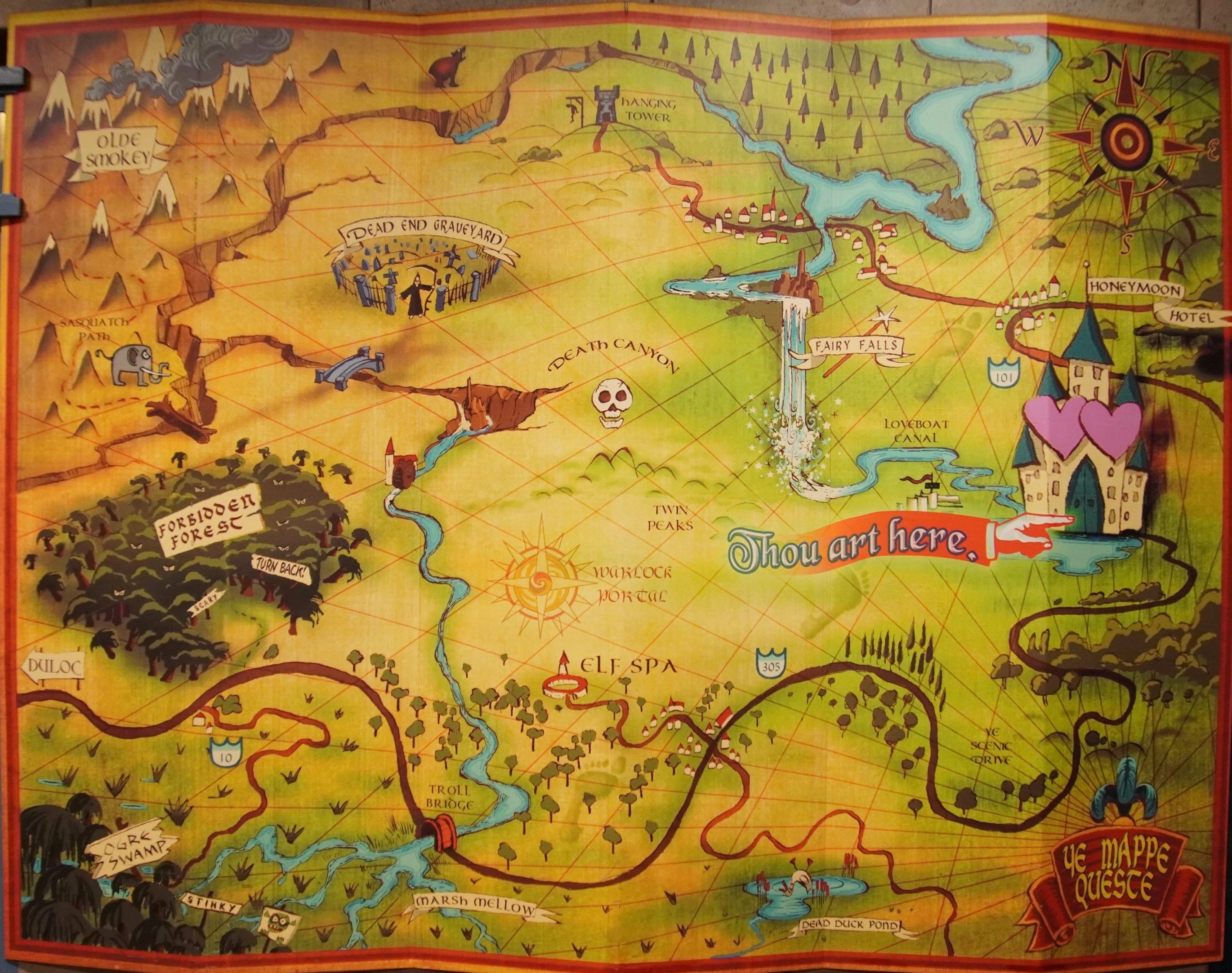
Here’s where the Harperverse framing comes in, because what DreamWorks built over four films, multiple shorts, two spin-off franchises, and two decades is a transmedia universe; even if nobody was calling it that at the time.
The core IP expanded across:
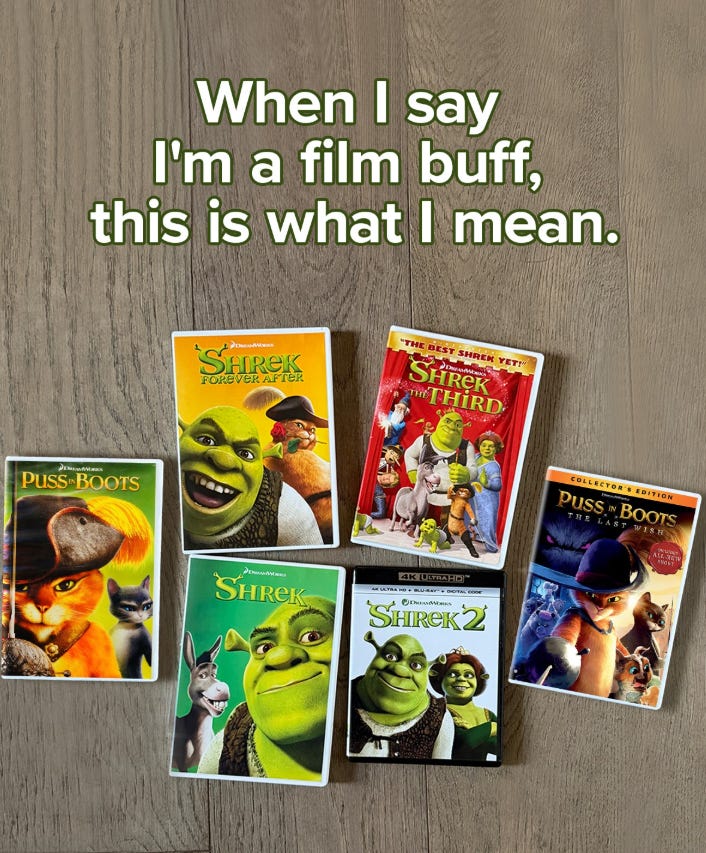
Film: Four main Shrek entries, plus Puss in Boots and its sequel, which continues to perform phenomenally; Puss in Boots: The Last Wish was a legitimate critical darling and box office success. More on the future in a moment.


Short Films & TV: The Shrek Halloween and Christmas specials, plus various short-form content that kept characters alive between theatrical releases. This is something studios often underinvest in, but DreamWorks used it consistently to maintain audience familiarity with the world.
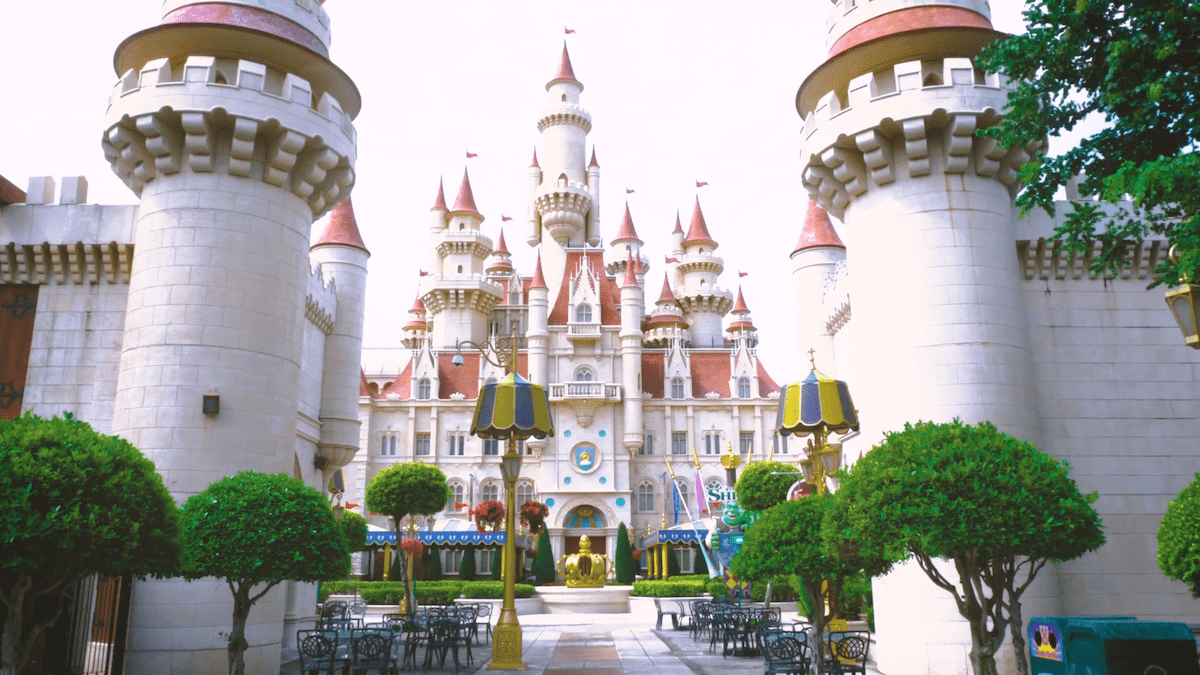
Theme Parks: This is where it gets really interesting. Far Far Away is a real place; or at least three of them. Universal Studios Singapore has an entire Shrek-themed land; think 40-metre-tall replica of King Harold’s Castle, a Donkey roller coaster, Puss in Boots’ Giant Journey, Donkey Live shows, the works. Then there’s DreamWorks Land at Universal Studios Florida (”Meet Shrek and splash in his swamp”). And closer to home, Shrek’s Adventure in London on the South Bank; an immersive walkthrough with live shows, characters, the full fairytale experience.
I haven’t been yet, but I should probably fix that. The theme park layer matters because it turns passive fandom into a physical experience and an ongoing revenue stream. It’s the same flywheel logic I talk about with Disney, the IP earns money across theatrical, streaming, merchandise, and real estate simultaneously.
The Meme Economy: And then there’s the thing nobody planned for. Somewhere around 2012-2016, Shrek became the internet’s favourite absurdist mascot, and that second life has arguably done more for the franchise’s longevity than any planned campaign could have. “Shrek is love, Shrek is life.” The Lord Farquaad memes. The endless remixes. The online fandom has maintained Shrek’s cultural relevance entirely independently of anything DreamWorks has done, which is a fascinating case of IP outliving its original marketing and being sustained by the audience itself.
The social content team clearly knows this too; posts like the “Raised by the swamp“ carousel, which riffs on how Shrek, Fiona, Pinocchio etc. each shaped a generation, get massive engagement precisely because they’re leaning into the joke the fans created. It’s the brand reabsorbing its own meme culture, and doing it with a light enough touch that it still works.
The 25th Anniversary Campaign
What DreamWorks Has Been Doing
So, what does a 25th anniversary for a franchise like this actually look like? Based on everything I’ve been tracking, the answer is: deliberately scattered, fandom-first, and surprisingly creative in places.
The theatrical re-release hit cinemas on May 15th in 4DX, Dolby, and D-Box formats, and the announcement post on the official Shrek and DreamWorks Instagram accounts - a simple insta collab with a poster and the caption “We still aren’t ogre it. Shrek is back in theaters May 15 for our 25-year anniversary” - pulled 218k likes. The comment section is basically just GIFs from every Shrek film and people saying “when the world needed him most… he returned,” which tells you everything you need to know about the strength of that fandom.
A follow-up video post - this time with Universal joining the collab - showed moments from the film over text highlighting the premium format options. The comments are glorious: “I watch Shrek weekly. My cats watch it with meeeeee.” Whoever let DreamWorks social team cook, deserves all the praise.
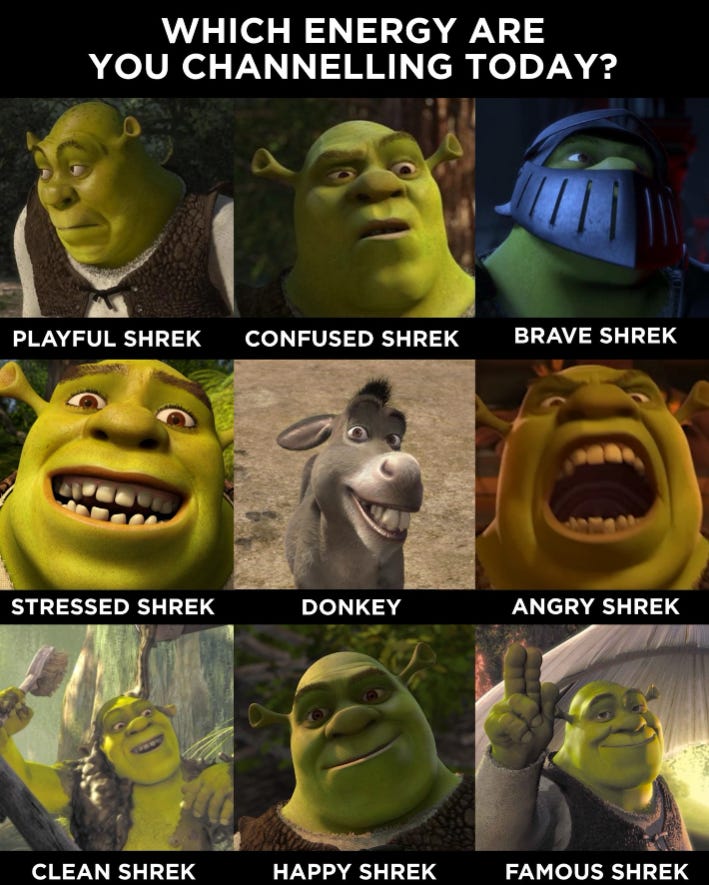
Cineworld also got involved, posting a simple energy/emotion carousel asking which Shrek vibe you’re channelling today, and Universal followed with a 4DX screening celebration post that captures the kind of genuine fan enthusiasm these anniversary screenings generate.


Beyond social, the merch layer for this anniversary is genuinely impressive in its range; from the prestige end all the way down to the wonderfully absurd:
Starting at the top: Swarovski released a collection of crystal figurines - Shrek, Fiona, Donkey, Gingy and inexplicably Puss in Boots (who doesn’t appear until Shrek 2, but whatever) - as part of the 25th anniversary. The collab post with the official Shrek account pulled 127k likes and the comments are full of people demanding Lord Farquaad and the Fairy Godmother get the crystal treatment. Swarovski’s feed is usually very clean and diamond-heavy, so dropping a big green ogre into it is a genuinely fun brand moment; here’s the official web page with a cool hero video too!
Then there’s the official LEGO set announcement - a franchise first - and the way they revealed it is probably my favourite piece of the whole campaign. Rather than a standard product shot, the announcement dropped as a full Shrek rave, referencing the viral Shrek: Forever Rave content by creator Danilovx (which has over 4 million likes on Insta alone). The LEGO set had become a cultural moment before anyone had even bought it. My mum, who sees the inside of a cinema maybe three times a year and has zero interest in film marketing, liked the post on Insta; that’s organically by the way, even without me or my siblings sharing it. That’s reach. The set is currently up for pre-order at £109.99.
The Outhouse popcorn collectible bucket is exactly what you’d expect given the popcorn bucket trend of the last two years; Shrek’s outhouse, removable Shrek figure, your snacks going where you’d probably rather not think about. Collectible, funny, completely on-brand. The popcorn bucket wave deserves its own post one day, but Shrek was always going to be perfect for it - I’ll add, whoever made that video above needs help, that is exactly on brand I know but it’s still gross! Anyway, AMC sell the bucket on their website alongside other new Shrek themed merch; Shrek cosplay t-shirt anyone?
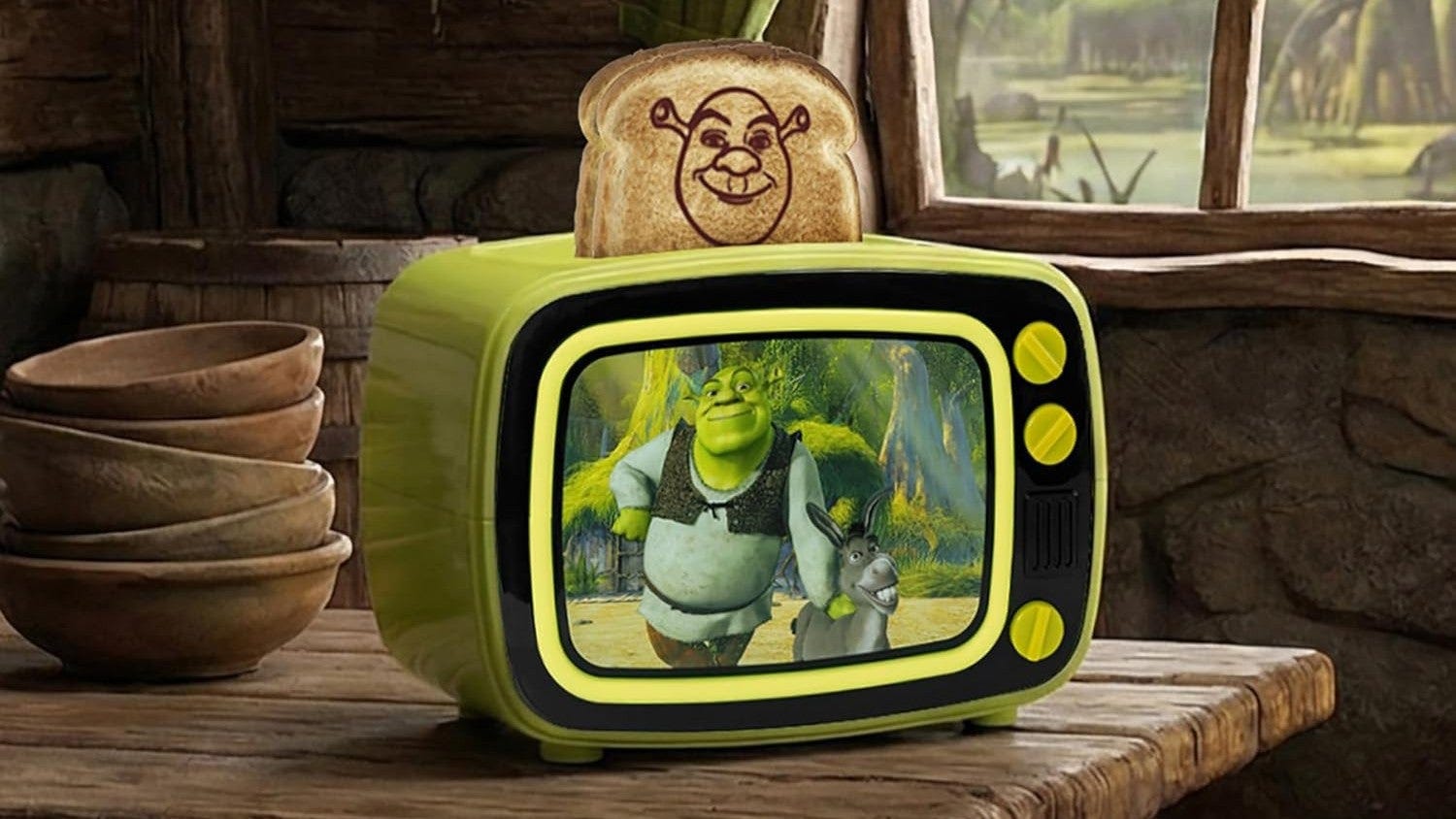
And then at the gloriously unhinged end of the spectrum: a $50 Shrek TV toaster that burns his face onto your bread. Not a new collab by any means; a product that exists because of course it does. IGN Deals covered it with the headline “[what’s the matter babe, you haven’t touched your shrekfast” and honestly, I respect it. This is Shrek merch reaching its natural limit and somehow still feeling on-brand.
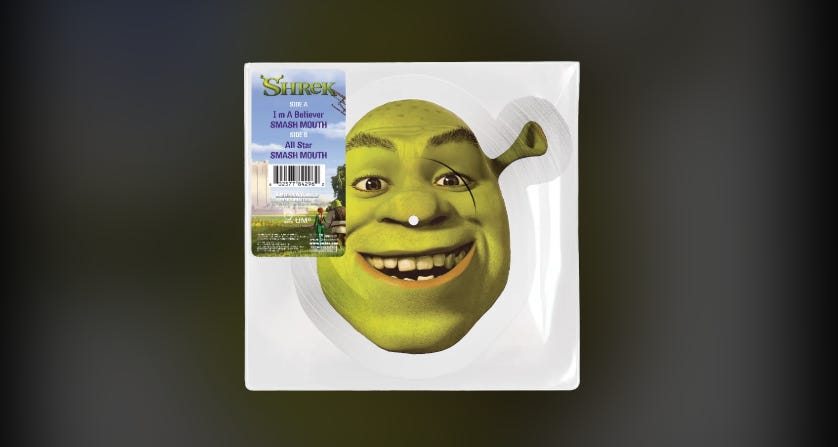
On the music side, Smash Mouth also marked their own anniversary - All Star and I’m a Believer also turning 25 - by teasing a mystery product via a Shrek silhouette, before revealing it as a vinyl record cut in the shape of Shrek’s head. Given that Steve Harwell passed away in 2023, there’s something genuinely touching about the band finding a way to commemorate that era with a physical object. The connection between Shrek and Smash Mouth is so ingrained in popular culture that it essentially sells itself at this point.
Finally - and this one is worth dwelling on - Mike Myers honoured Eddie Murphy at the 51st AFI Life Achievement Award tribute in April by showing up in full Shrek makeup. He called Murphy’s performance as Donkey a “masterpiece” and credited him with the franchise’s success. That’s a 25-year friendship, a genuine tribute moment, and free earned media that no P&A budget could replicate.
So What Does Shrek Actually Teach Us?
The easy answer is that Shrek is proof that great IP outlives its marketing. And that’s true; it’s also a bit of a lazy answer.
What Shrek actually demonstrates is that when a character resonates deeply enough, the fandom becomes a co-author of the cultural narrative. DreamWorks didn’t create Shrek meme culture. The internet did. But DreamWorks has been smart enough to let it happen, lean into it, and now the official accounts speak fluent fandom without it feeling forced. That’s harder than it looks. Plenty of studios try to reclaim their meme IP and just end up looking like a parent doing the floss at Christmas dinner.

The original campaign - the Barbara Walters interview, Shrek and Donkey at the Oscars, them also appearing in their own brand collabs - showed an early willingness to let these characters exist in the real world, not just on screen. That blurring of the line between fiction and reality is the foundation of transmedia storytelling, even if nobody was using that language in 2001. It’s what I wrote about in my Beyond the Trailer post, it’s what the best franchise campaigns still do today, and it’s what makes Shrek feel so alive across so many formats 25 years on.
The 25th anniversary campaign won’t be remembered as the most ambitious in Hollywood history. But it’s warm, fan-fluent, and it trusts the audience to show up because the audience never really left.
We still aren’t ogre it. Clearly.
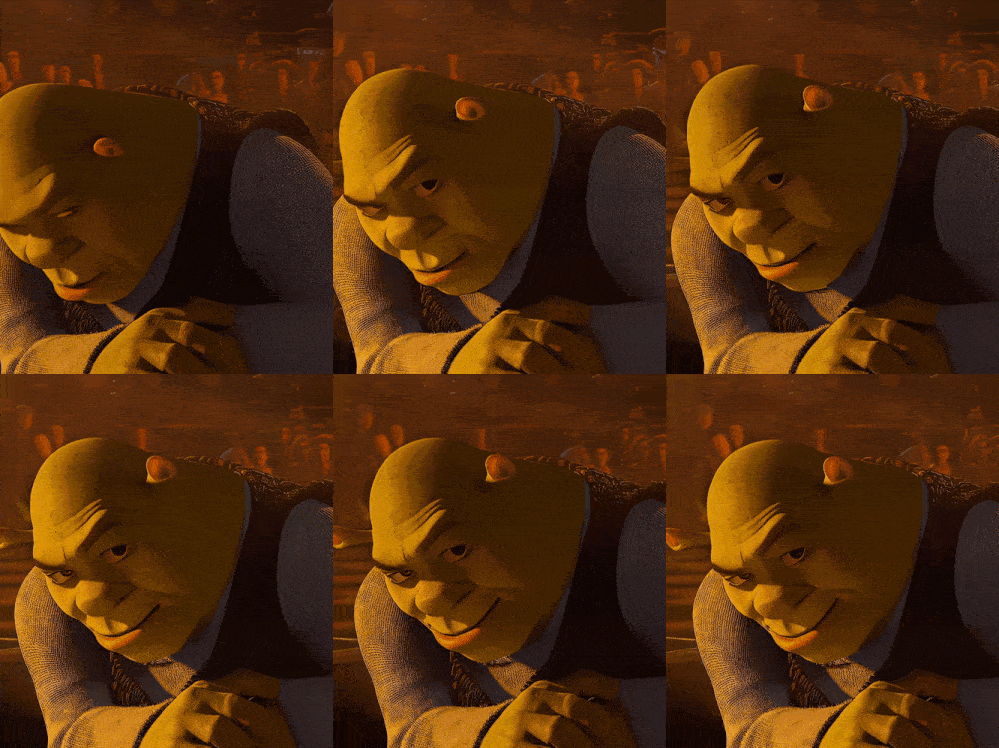
If you want to go deeper into the Shrekiverse, the Instagram account shrekhistory offers a rabbit hole of concept art, vintage ads, and merch drops worth losing an hour to. And daniella_movies has been posting a brilliant archive of original campaign content that a lot of this post draws from.
Thanks for reading The Harperverse!
If this is the kind of breakdown you’re into, consider subscribing. It genuinely helps fund the cinema trips, the research rabbit holes, and the posts like this one.
Most uncredited images will have been taken from the films TMDB page!